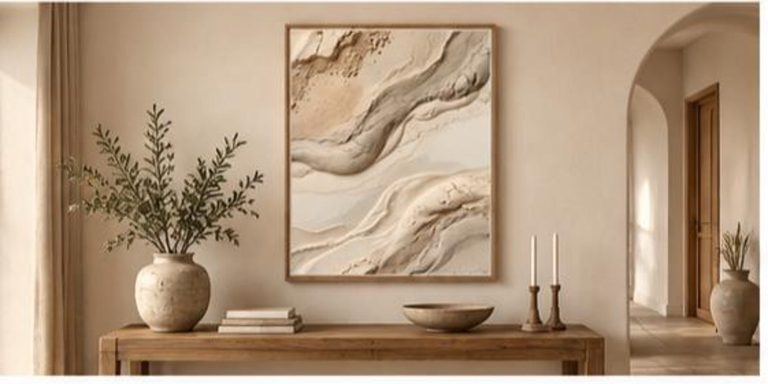
Abstract Line Art Ideas for Modern Interiors
The painter Paul Klee is often quoted as describing a line as a dot that went for a walk.
Abstract line art takes that idea and lets the walk become the whole picture. There is no leaf, no face, no building to depict. The subject is the line itself: its curve, its speed, its weight, the way it meets other lines and the space it leaves.
This guide gathers practical ideas for abstract line art in modern interiors: the main types, how to style them room by room, how to combine them with colour and texture, and how to choose pieces with real presence. If you’re new to the area, start with minimalist line art and our pillar guide to what abstract art is.
What Is Abstract Line Art?
Abstract line art is artwork built primarily from lines that do not depict any recognisable object. Where botanical or figurative line art suggests a subject, abstract line art asks you to respond to the line as movement and form.
It sits at the meeting point of two ideas already covered on this site: the non-representational language of abstraction and the economy of minimalism. Wassily Kandinsky wrote about the expressive character of line in his 1926 book Point and Line to Plane, an early sign of how seriously artists have thought about it.
How It Differs From Minimalist Line Art
They overlap, but the emphasis differs.
- Minimalist line art usually depicts something (a branch, a face, an arch) using as few lines as possible.
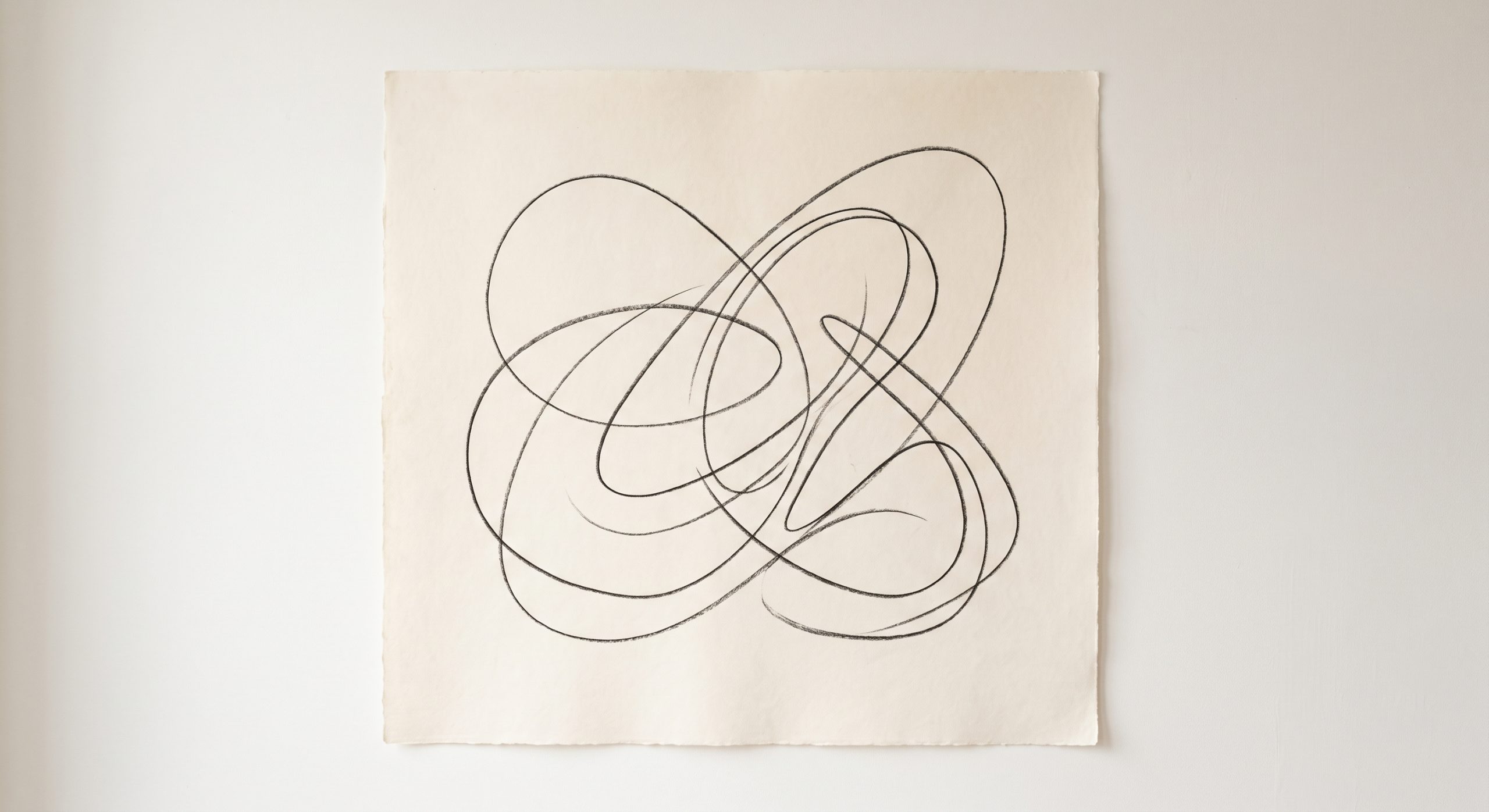
- Abstract line art depicts nothing. It may be minimal or it may be richly layered, but the line is always the subject.
A single sweeping curve can be both. What matters is whether the line is describing a thing or being one.
Abstract Line Art Ideas
1. Flowing, overlapping curves
Several soft curved lines cross and loop over each other, forming shapes where they overlap. The effect is fluid and organic, and it suits bedrooms, living rooms and any space where you want a gentle sense of movement. It pairs naturally with the softness described in organic abstract art.
2. Geometric and architectural lines
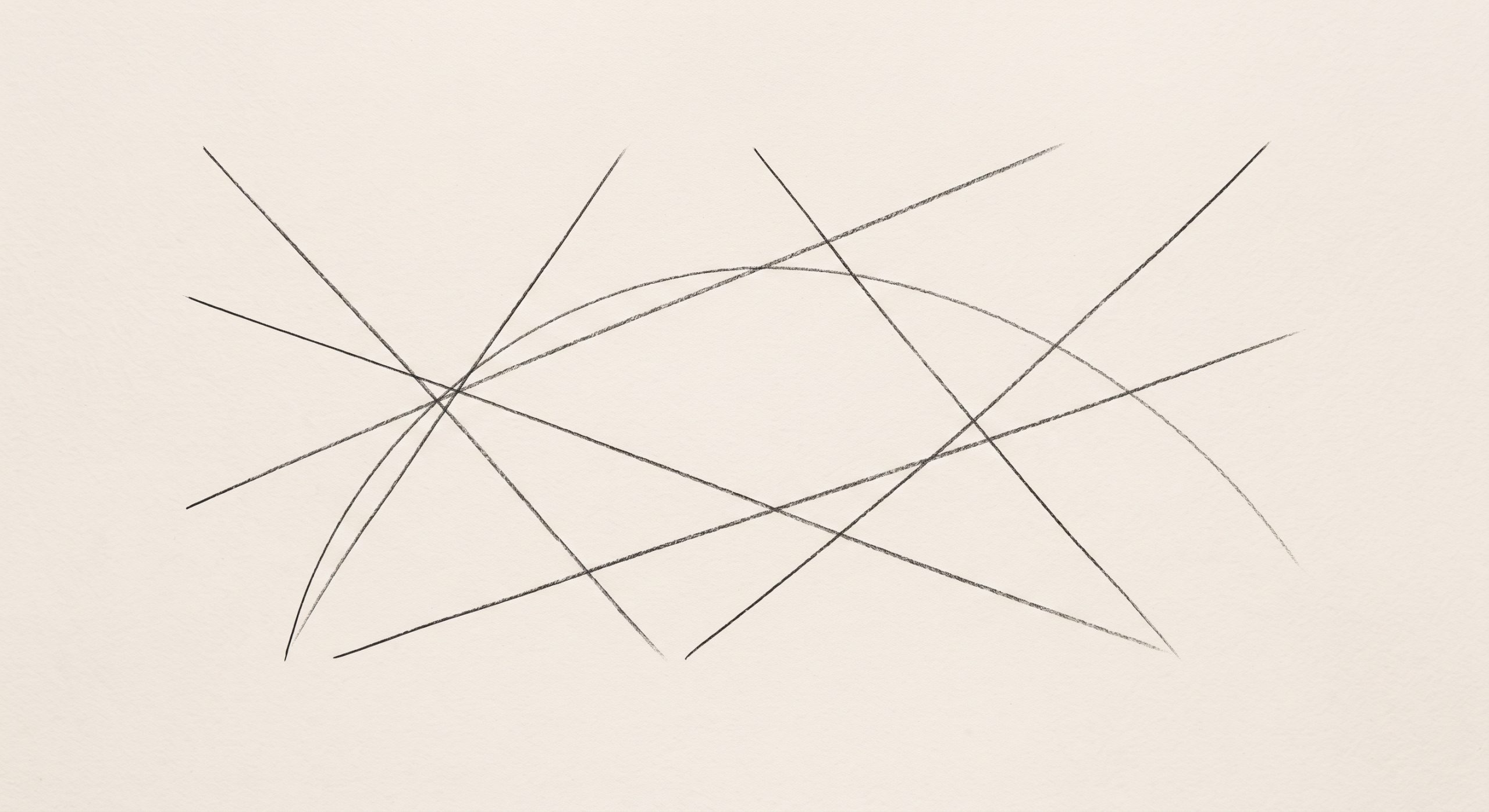
Straight lines crossing at calm angles, sometimes softened by a single arc. This feels structured and modern and works well in rooms with clean architecture, shelving or glass.
3. The single continuous line
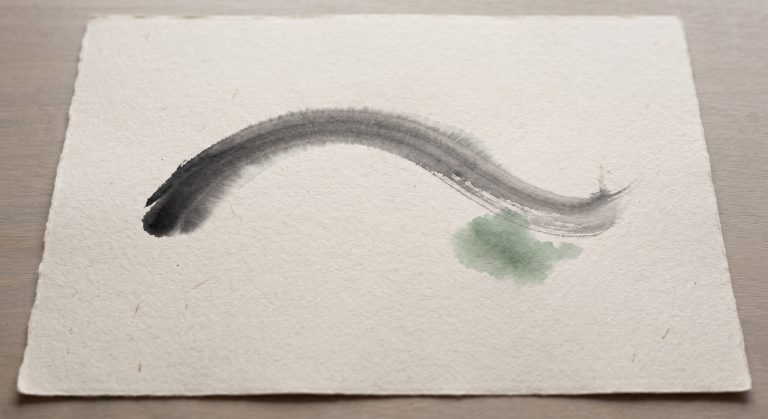
One unbroken line that loops and folds into an abstract form. It has a meditative rhythm and a strong sense of gesture. It is also one of the most reliable ways to add presence without visual noise.
4. Line with a soft colour shape
A fine line drawn over or around a muted wash of colour, such as sage, clay or dusty rose. The colour adds warmth while the line keeps it crisp. Keep the colour desaturated so it behaves like a neutral. For palette guidance, see how colour changes the feeling of abstract art.
5. Line with texture
A delicate line across a plaster-like or mineral surface. The contrast between crisp line and tactile ground is surprisingly powerful. See textured abstract art.
6. Parallel and rhythmic lines
Repeated, evenly spaced lines with slight variations create rhythm and calm. This idea draws on minimalism’s love of repetition, explored in what minimalist art is.
7. Metallic or gold-toned accents
A single line in muted gold or bronze against a neutral ground catches the light and adds a quiet glow. It works best when used sparingly and in a matte or brushed finish rather than a high shine.
8. One line across a set
A line that continues from one panel to the next across a diptych or triptych. It turns a set of separate pieces into a single composition, and it gives a wide wall a clear rhythm.
What Makes Abstract Line Art Feel Considered
Because the elements are so few, quality shows quickly. Look for these qualities:
- Confident gesture. The line moves with purpose. Hesitation reads as timidity.
- Consistent or deliberate weight. Random variation looks accidental.
- Balance. The visual weight of the lines is distributed so the composition settles. See understanding balance in abstract art.
- Negative space. The empty area is composed as carefully as the lines. See negative space in abstract art.
- Tension. A piece needs some energy, a curve that pulls or a line that crosses, to hold a wall.
Abstract Line Art Room by Room
- Living room: a large single-line piece above the sofa, or a triptych with a continuous line across it.
- Bedroom: flowing, low-contrast curves above the bed for a restful mood.
- Hallway: a tall, narrow piece or a row of matching frames to create rhythm.
- Home office: geometric lines for a focused, structured feel.
- Dining room: a wide horizontal piece with generous negative space.
Choosing the Ground and the Line Colour
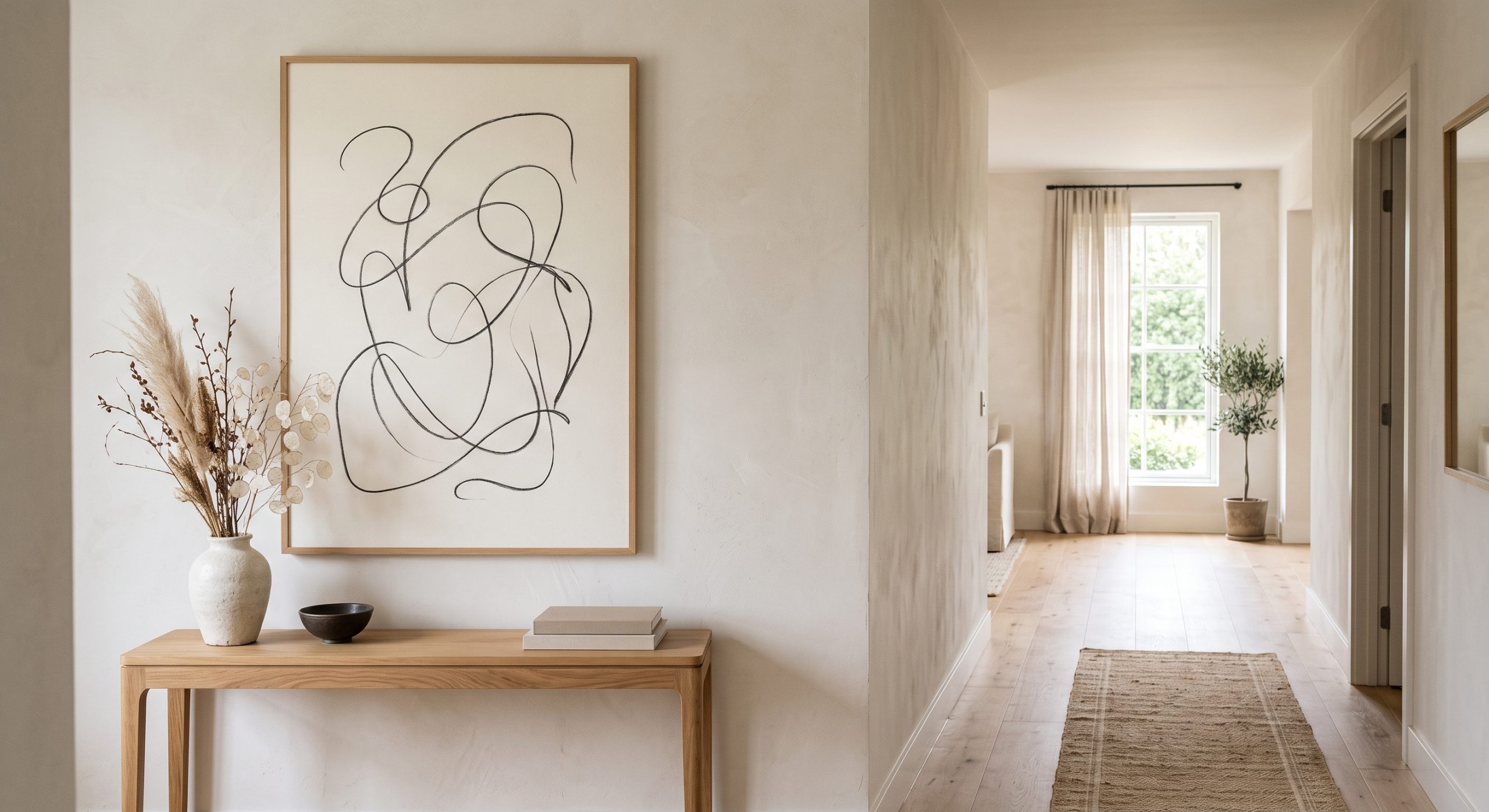
Black on white is crisp and graphic. Charcoal or deep brown on warm ivory, cream or oatmeal paper is softer and easier to pair with natural materials. Coloured lines, such as terracotta, sage or navy, can work if the palette is otherwise restrained.
Scale and Framing
Fine line work benefits from scale and space. A large piece with a wide mat, the paper border inside the frame, gives the lines room to breathe, whereas a small piece crowded into a busy wall can look lost. Slim frames in pale wood, black or white are usually the safest choice. For scale and placement, see how to choose abstract art for your home.
Combining Line Art With Other Work
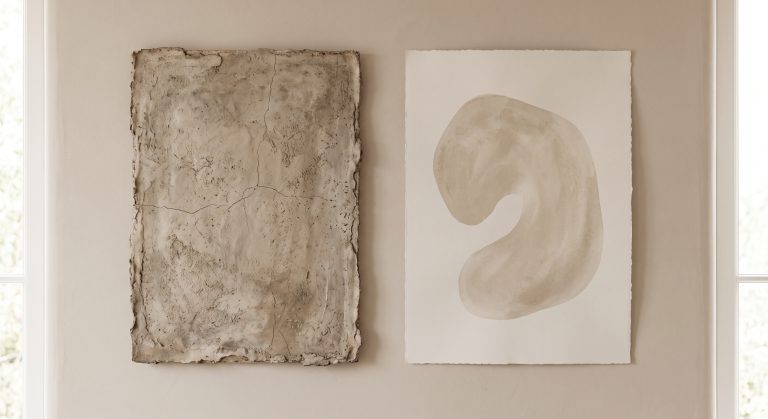
Line art holds a wall more confidently when it has a contrast partner: a textured piece, a soft colour-field piece or a small sculptural object. Keep a shared palette so the pieces feel related. A calm, Scandinavian-Japanese room, described in what Japandi art is, is an ideal setting for gentle line work.
Common Mistakes
- Choosing lines that are too thin for the size of the wall
- Crowding several line pieces so they compete
- Using stark white paper against a warm-toned room
- Selecting purely decorative squiggles with no sense of direction
- Skipping the mat, which makes delicate work look flimsy
Final Thoughts
Abstract line art proves how much a simple mark can carry.
Choose a line that moves with intent, give it plenty of space, and let one piece do the work. In a modern interior, few things are quieter or more quietly expressive.