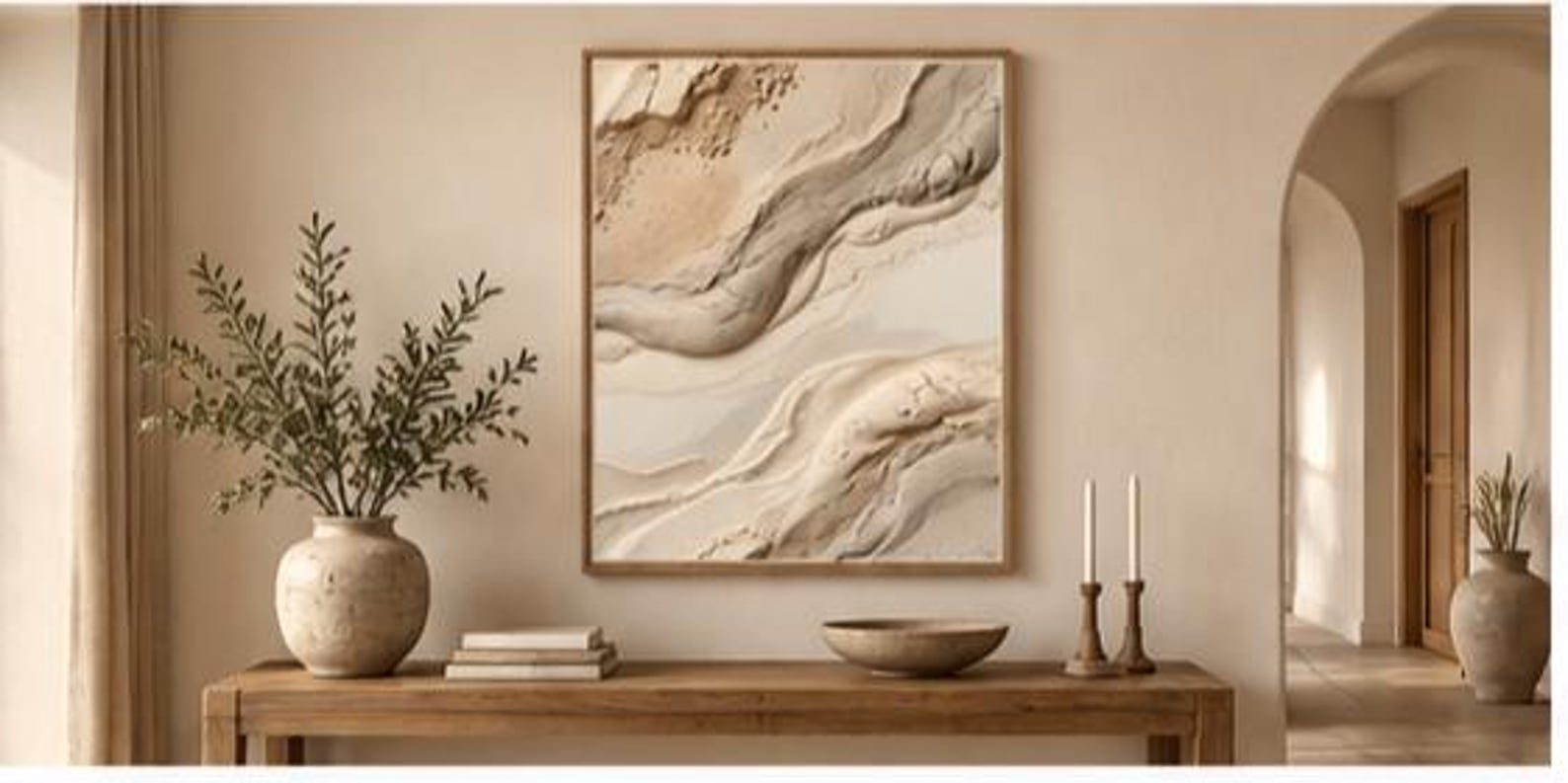
Japandi Wall Art for Small Home Offices
Japandi wall art suits a small home office because it does what a workspace needs: it adds calm and warmth without adding visual noise. In practice that means one or two pieces rather than many, a restrained neutral palette, plenty of empty space around the art, and simple forms such as a single brushed line or a soft organic shape, framed in natural wood. Place the piece you want to look at where your eyes rest when you look up from the screen, and keep the wall behind you quiet if you are often on video calls.
If you are new to the style itself, what Japandi art is covers its background. This guide is about applying those principles to a small workspace: which wall, which shape, what size and which kind of image.
Why Japandi Works in a Small Workspace
Japandi blends Japanese restraint with Scandinavian warmth and practicality. Both traditions value function, natural materials and uncluttered space, which happen to be exactly what a small office benefits from. A busy wall competes with the work on your screen; a calm one gives your eyes somewhere to rest.
The aim is not an empty room. It is a room where everything you can see has earned its place.
Reduce Visual Noise First
Before choosing art, clear the wall. In a small office, the art only works if it is not competing with clutter.
- Remove or hide pinboards, cables and paperwork from the wall you look at most.
- Choose one main piece, or a carefully spaced pair, rather than a gallery wall.
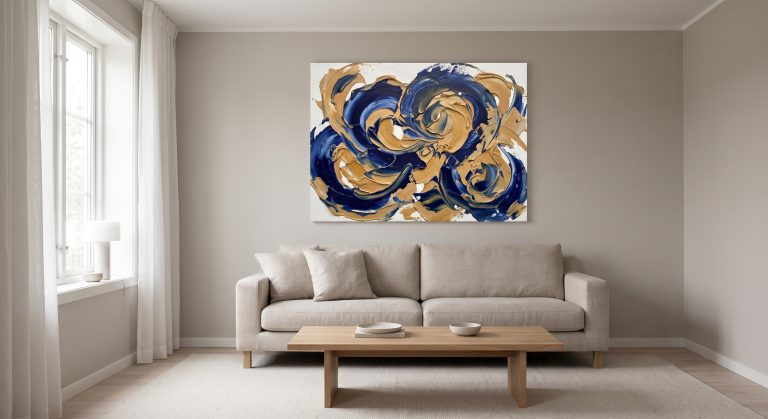
- Avoid busy, high-contrast or brightly coloured art, which keeps pulling attention.
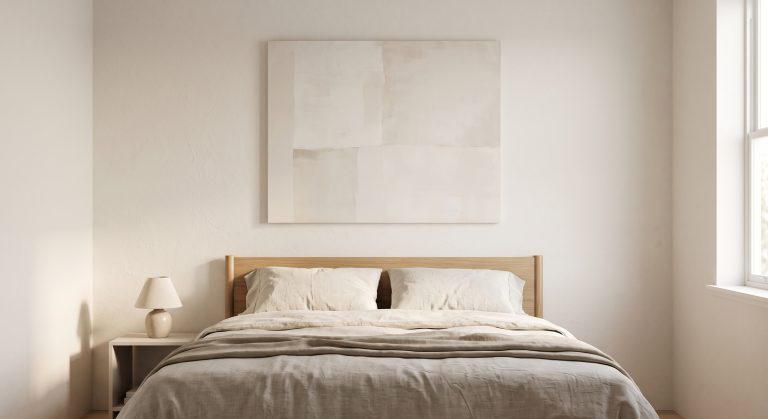
- Repeat colours that are already in the room: wood, linen, stone, soft white.
Which Wall? Facing the Desk vs Behind It
The wall you face
If your desk faces a wall, that is where your eyes go every time you look up. Art here should be restful: low contrast, soft forms, generous negative space. A minimal landscape or organic abstract works well, giving your eyes a moment’s distance from the screen.
The wall behind you
This is the wall your camera sees. Japandi art makes an excellent video-call background because it looks calm and considered without distracting colleagues.
- Keep it simple: one piece, roughly centred in the camera frame or placed slightly to one side.
- Avoid glass in direct line with a window or lamp, which creates glare on camera. Matte paper and low-reflection glazing help.
- Check it on camera before hanging, so the frame is not cut off awkwardly at the edge of the shot.
The wall beside the desk
Often a narrow strip of wall beside a desk or window is the most natural spot for art in a small office. This is where portrait-format pieces shine.
Portrait or Landscape?
- Landscape suits the wall above a desk, echoing the desk’s horizontal line. Aim for art roughly two-thirds of the desk’s width.
- Portrait suits narrow walls, alcoves, the space beside a window, and offices with low ceilings, where a tall shape adds height.
- A pair of portrait pieces can replace one landscape piece above a desk, and feels slightly more rhythmic and Japanese in spirit.
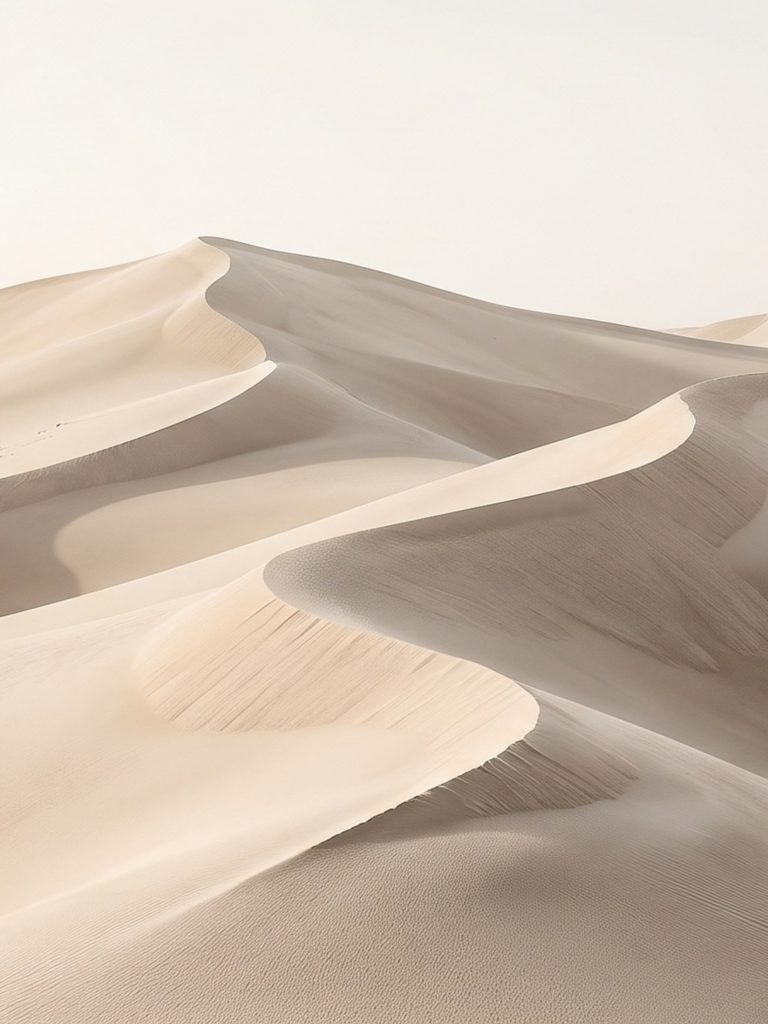
Our Quiet Dunes print is an example of a calm portrait piece that works above a desk, alone or as one of a pair: soft, wind-shaped dunes beneath a pale sky, so it rests the eye rather than drawing it. For a narrow wall beside a window, a tall piece such as Sandstone Flow Texture or Soft Sand Contours fits the space without crowding it.
Five Kinds of Japandi Art That Suit an Office
1. Minimal line art
A single continuous line or a few brushed strokes on a pale ground. Line art is the most restrained option, ideal for very small rooms. See minimalist line art and abstract line art ideas.
2. Organic abstraction
Soft, rounded shapes inspired by stones, sand and plants. Curved forms tend to feel calmer than sharp geometry, which is why organic abstract art suits a room where you need to concentrate.
3. Brushwork and ink-inspired pieces
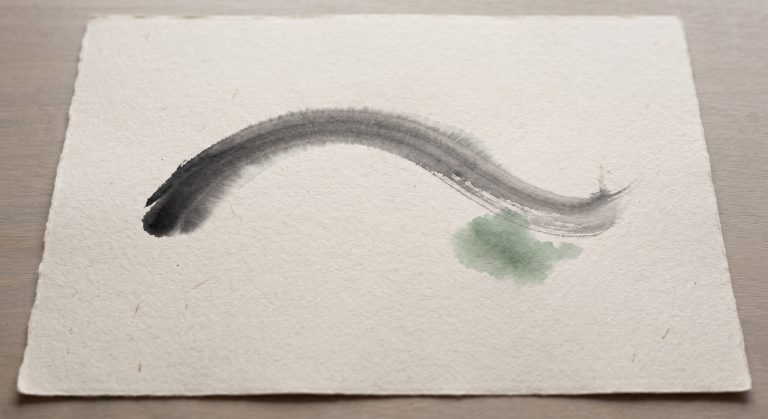
Loose, single-colour brushwork, sometimes inspired by the Zen ensō (a circle painted in one stroke), brings the Japanese side of Japandi into the room. Choose soft charcoal or sepia rather than stark black if the rest of the room is warm.
4. Minimal landscapes
A horizon, a dune, a hill reduced to a few lines. These give a small room a sense of distance, which is welcome when you spend hours focused on a screen.
5. Natural textures
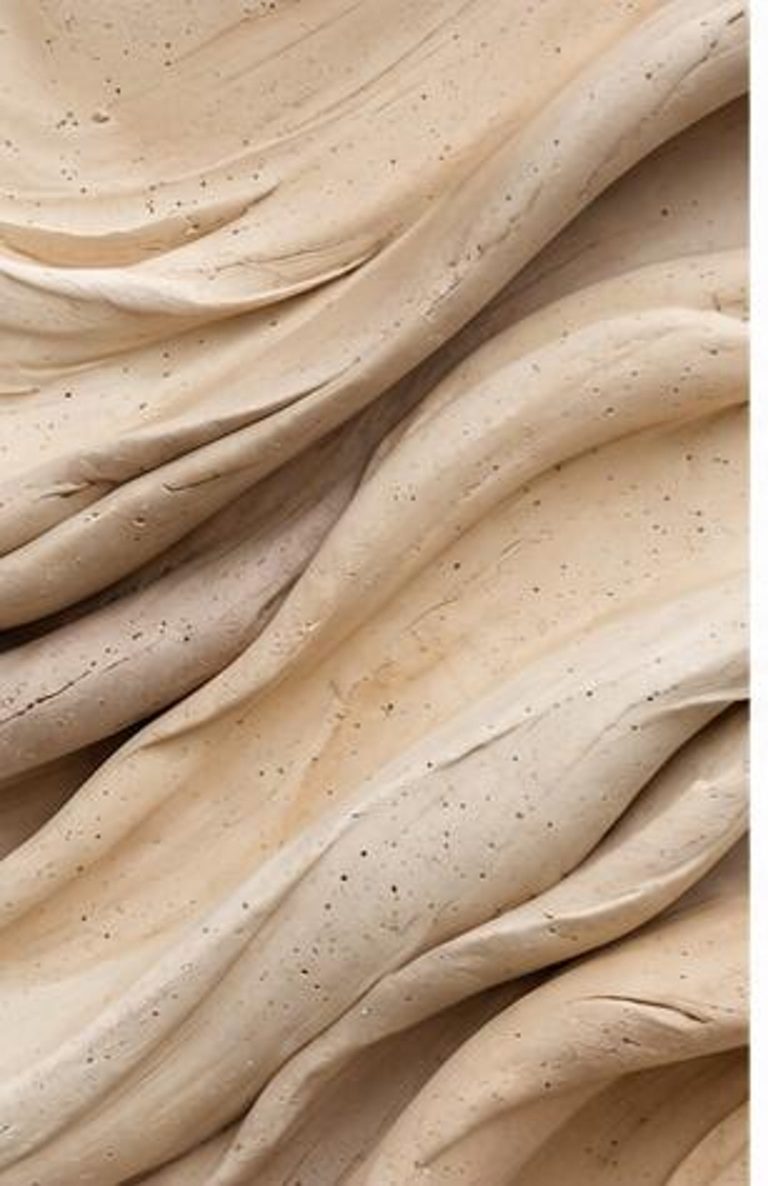
Stone, sand, plaster and paper textures, whether physically textured or printed to show the look of texture, echo the natural materials central to Japandi. The quiet imperfection of these surfaces also connects with wabi-sabi, the Japanese appreciation of beauty in imperfection.
Use Negative Space Deliberately
Negative space, the empty area around and within a composition, is central to Japandi. In a small office, use it twice:
- Within the art: choose pieces with open areas, rather than compositions filled edge to edge.
- Around the art: leave generous bare wall around the piece, and use a wide mount to create breathing room inside the frame.
See understanding negative space in abstract art for why empty space reads as calm.
Keep to a Neutral, Natural Palette
- Base tones: warm white, oatmeal, sand, stone.
- Depth: taupe, clay, soft charcoal.
- Accents (sparingly): muted sage, olive or terracotta, ideally picked up from a plant or a ceramic on the desk.
Our Neutral Abstract Printable Wall Art Collection sits entirely within this warm, earthy range.
Bring in Warm Wood
Wood is what keeps Japandi from feeling cold.
- Frame the art in pale oak, ash or bamboo to echo a wooden desk or shelving.
- Match the undertone: a honey-toned desk suits warm oak frames; a walnut desk suits a darker frame or a pale frame for contrast.
- Use a thin frame moulding. Heavy frames feel out of place in a restrained room.
What Size Should the Art Be?
Small rooms tempt people to choose small art, but tiny prints scattered on a wall create more visual noise, not less. One well-sized piece is calmer.
| Where | Suggested size |
|---|---|
| Above a 100–120 cm desk | Around 60–80 cm wide, such as 50×70 cm landscape or a pair of A3 or 12×16 in pieces |
| Narrow wall beside a desk or window | A tall portrait piece, such as 30×40 cm, 40×50 cm or 12×18 in |
| Video-call background | Large enough to read on camera; usually 50×70 cm or 18×24 in and up |
| Shelf or desk leaning piece | A4, A5, 8×10 or 5×7 in, in a simple wooden frame |
Hang art above a desk so the bottom of the frame sits roughly 20 to 25 cm (8 to 10 in) above the desktop, high enough to clear a monitor but close enough to read as one arrangement. See how high to hang wall art and how big wall art should be for more detail.
Common Mistakes
- A gallery wall in a tiny office, which adds the visual busyness Japandi avoids.
- Bright, high-contrast art on the wall you face while working.
- Glossy prints or glass that catch lamp or window glare, on camera or in your eyeline.
- Cold, grey-only palettes with no wood or warm tones, which feel sterile rather than calm.
- Art too small for the wall, which looks lost.
- Covering every wall. Leaving one wall bare is part of the style.
Final Thoughts
Japandi wall art turns a small home office into a calmer place to work by subtracting rather than adding. Clear the wall, choose one restful piece for the wall you face, keep the wall behind you simple for the camera, and frame everything in warm, natural wood with plenty of space around it. The result feels quiet, warm and focused.
For more on the style, see Japandi art’s Japanese and Scandinavian influences and minimalist artwork for small spaces.