How Big Should Wall Art Be?
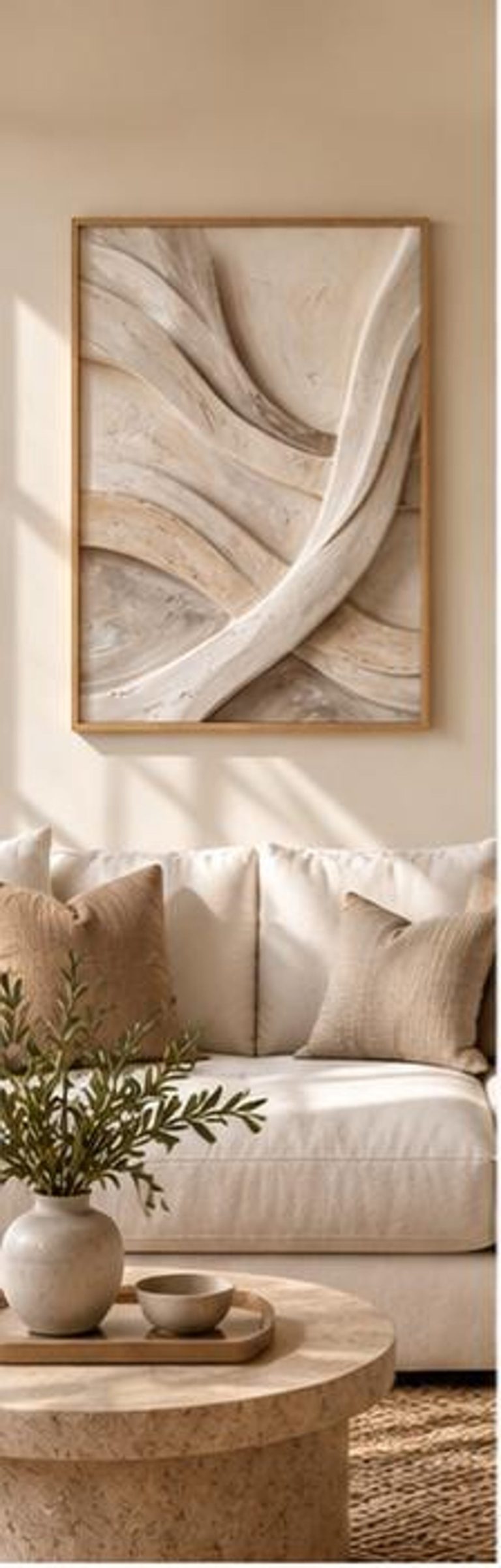
How big should wall art be? Above furniture, it should usually span roughly two-thirds to three-quarters of the furniture’s width. On an empty wall, aim to fill somewhere between 50% and 70% of the available space, leaving a visible margin all round. Those two guidelines solve most sizing problems, and a paper template taped to the wall will confirm the choice before you buy.
Undersized art is the most common reason a piece that looked beautiful in the shop looks disappointing at home. It is rarely the artwork’s fault; it is almost always scale. Get the size right and even a modest print looks settled and deliberate, as though the wall was built around it.
Below, you will find how to measure, when to break the rule, and how height fits in. For placement and mood, see how to choose abstract art for your home.
The Basic Rule: Two-Thirds to Three-Quarters
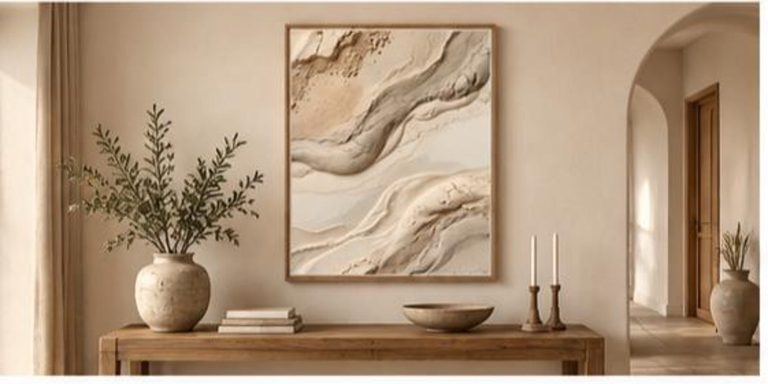
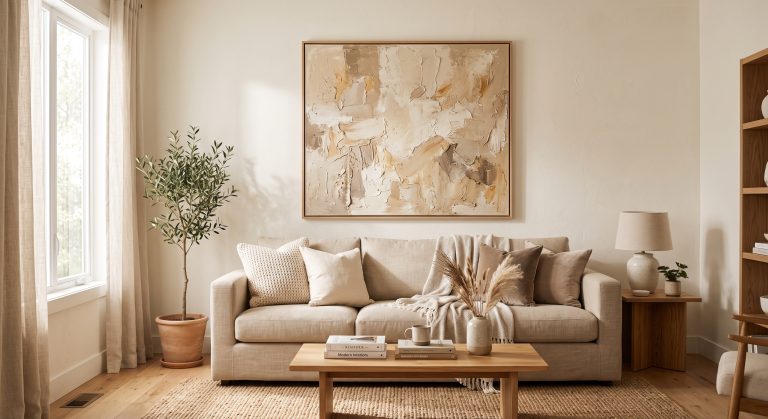
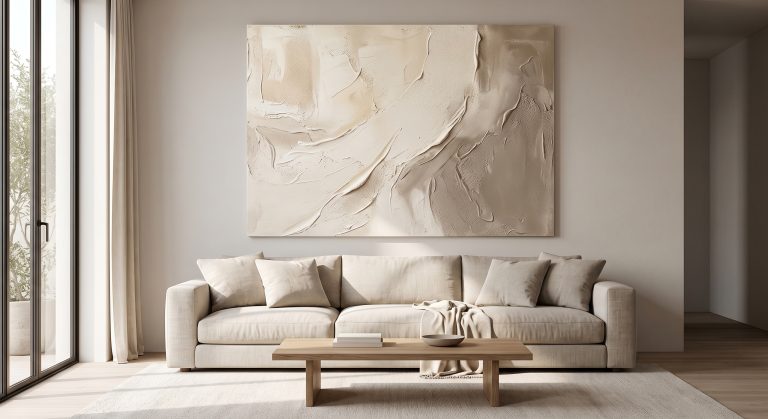
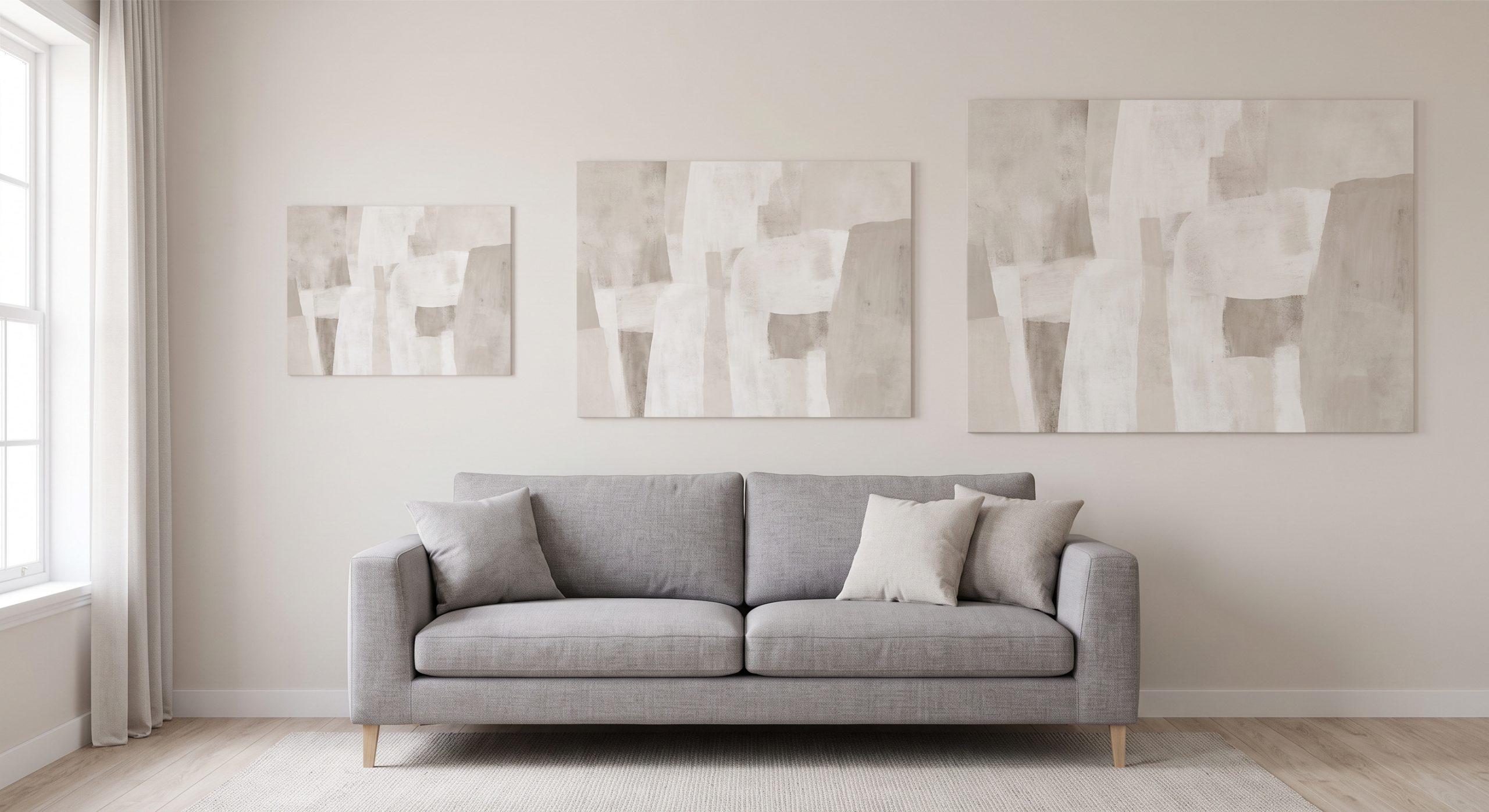
For art hung above a piece of furniture, such as a sofa, bed or console, a widely used guideline is that the artwork (or the group of artworks, including gaps) should span roughly two-thirds to three-quarters of the furniture’s width.
Below that range, a piece tends to look stranded, floating on the wall like a postcard. Above it, the art can start to overwhelm the furniture rather than complement it. This is a starting point rather than a strict law, but it prevents the single most common sizing mistake.
Sizing for an Empty Wall
Without furniture to reference, use the wall itself. A common approach is to fill somewhere between 50% and 70% of the available wall space, leaving visible margin on all sides so the piece reads as placed rather than crammed in.
How to Measure Before You Buy
- Measure the furniture you are hanging above, or the wall itself if there is none.
- Multiply by 0.66 and 0.75 to get your target width range.
- Cut a paper template at that size, or several sizes within the range.
- Tape it to the wall and view it from where you will actually sit or stand.
- Leave it up for a day if you can, since first impressions can shift once you have walked past a few times.
For example, a 210 cm sofa gives a target width of roughly 139 to 158 cm, either as one piece or as a group including the gaps between frames. If you are buying printable art, our printable wall art size guide shows which file ratio fits each standard frame.
When to Break the Rule
The two-thirds to three-quarters guideline is a default, not a ceiling. There are good reasons to go larger:
- A very tall or wide wall with little other furniture can carry an oversized piece as the room’s main feature.
- A deliberately dramatic room where the art is meant to dominate rather than support.
- A piece that reads as sculptural and is meant to be seen independently of any single piece of furniture.
And reasons to go smaller:
- A gallery wall, where several smaller pieces together reach the target width. See how many pieces should be in a gallery wall.
- A narrow hallway or small nook, where a smaller, well-placed piece is more appropriate than a large one. See wall art for narrow hallways.
Getting the Result Right
When the size is right, the art and the furniture beneath it read as a single, considered arrangement. The wall around the piece frames it rather than swallowing it, and the eye settles instead of searching.
Height Matters Alongside Width
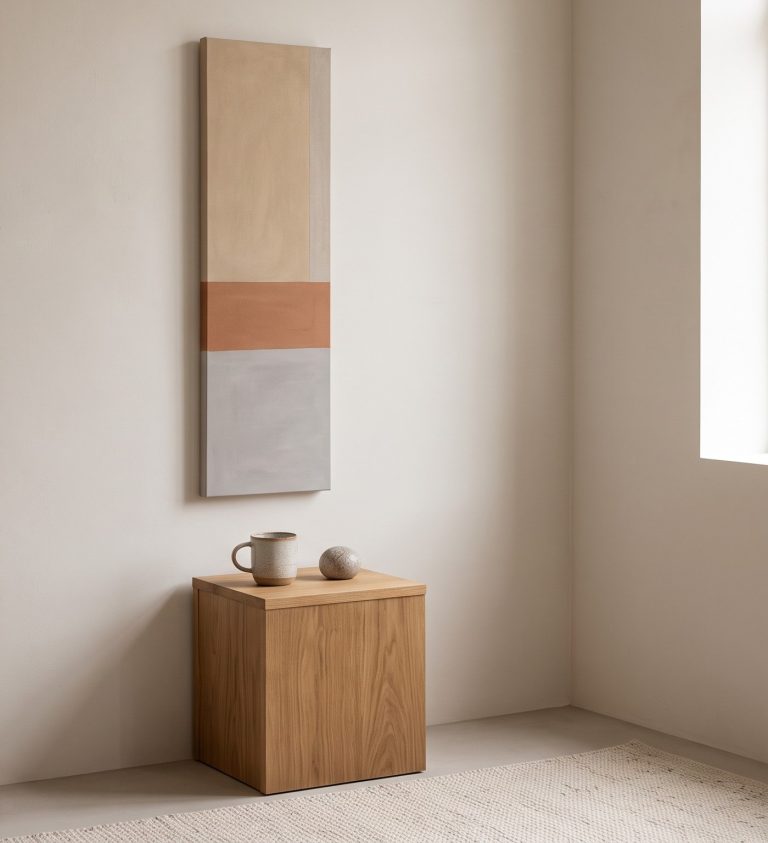
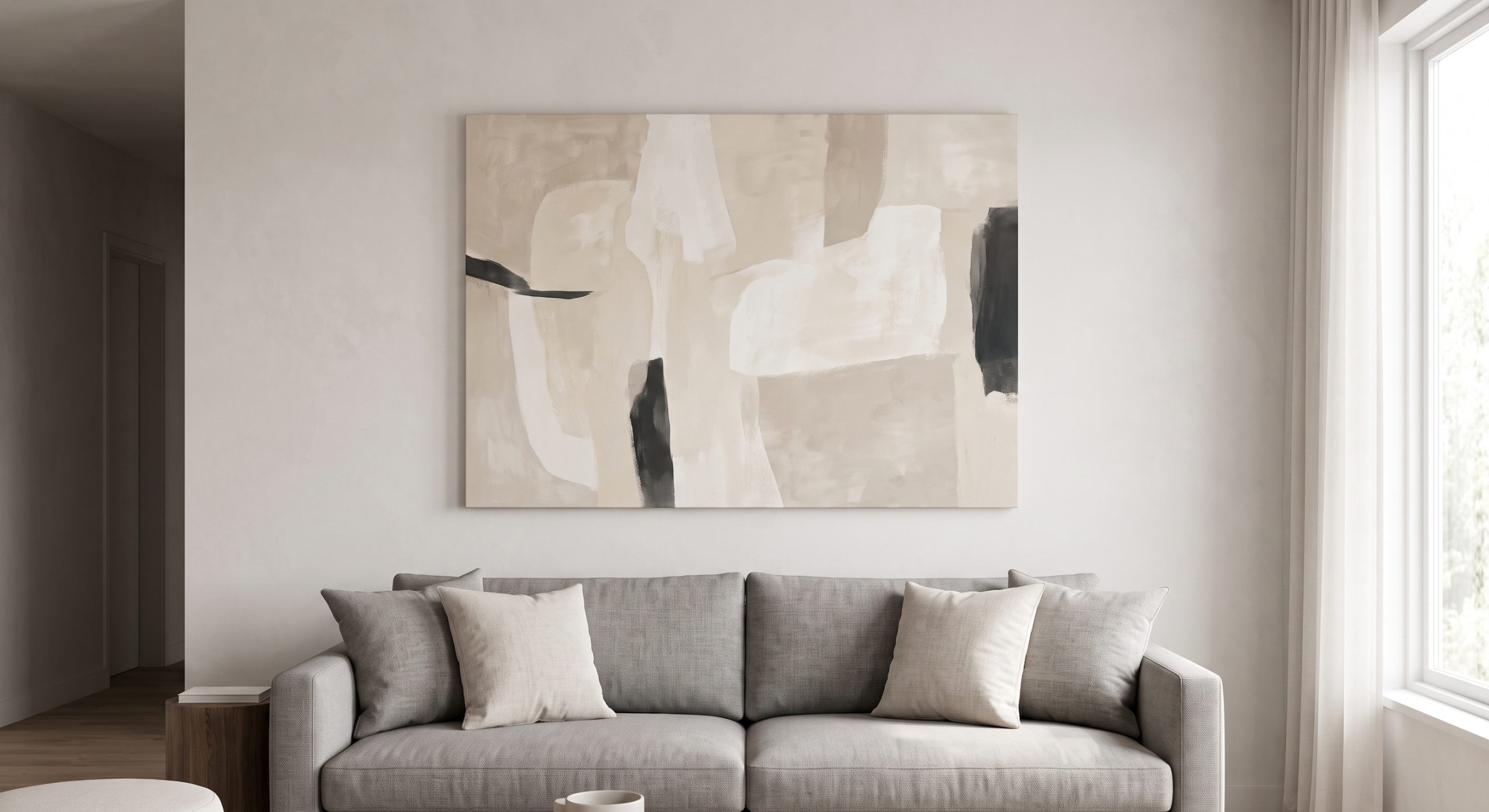
Size is not only about width. A piece with the right width but an unusual height, very tall and narrow, or very short and wide, can still look wrong if the proportions do not suit the wall. Consider both dimensions together, and see how high should you hang wall art for placement once size is settled.
Common Mistakes
- Buying based on how a piece looks online, without measuring the wall first
- Choosing art that matches a chair’s width rather than the whole furniture group
- Assuming bigger is always better, without checking the room can support it
- Ignoring height in favour of width alone
- Skipping the paper template test
Final Thoughts
Getting the size right is one of the least glamorous parts of choosing art, and one of the most important. A modest piece, correctly scaled, will always look better than a beautiful piece that is the wrong size for its wall.
Measure first, test with paper, and let the size follow the room rather than the other way around.