What Is Minimalist Art?
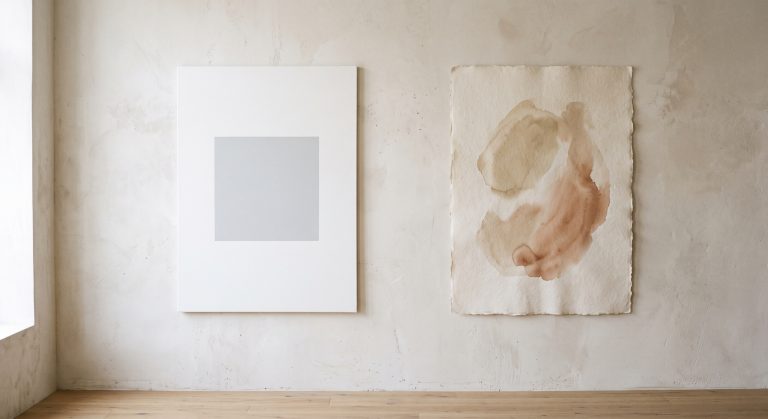
Minimalist art looks like it has almost nothing to say. A single line. A few rectangles. A large, quiet surface.
And yet it is some of the most carefully considered art there is. When you remove almost everything, whatever remains has to be exactly right: its position, its proportion, the space around it.
This guide explains what minimalist art is, where it came from, what defines it, how it differs from abstract art and from minimalist decor, and how to live with it at home. If you’re new to art terminology, our pillar guide to what abstract art is is a helpful companion.
What Is Minimalist Art?
Minimalist art is art that reduces its visual language to the fewest possible elements.
Instead of a scene, a story or an expressive gesture, it offers simple forms, limited colour, clean surfaces and a strong sense of order. Nothing is there for decoration. Every element is doing a job.
The term is used in two slightly different ways, and it helps to know both.
Minimalism as an art movement
With a capital M, Minimalism refers to a specific group of artists working mainly in the United States from the 1960s onwards. Their work is often made of industrial materials, arranged in simple geometric forms, with no attempt to represent anything.
Minimalist as a general style
In everyday use, particularly when people shop for art, “minimalist” describes work that is simple, restrained and uncluttered. That might be a single line drawing, a quiet abstract in neutral tones, or a geometric print. It borrows the spirit of the movement without belonging to it.
Most of the time on this site, we mean the second sense. But knowing the first gives the second much more depth.
Where Minimalist Art Came From
The roots go back further than the 1960s.
In 1915, the Russian artist Kazimir Malevich exhibited his Black Square, a painting that stripped art down to a single dark shape on a pale ground. Piet Mondrian, working over the following decades, reduced his compositions to straight lines and a handful of primary colours. Both are often cited as forerunners of the reductive approach that Minimalism would later take much further.
The architect Ludwig Mies van der Rohe is associated with the phrase “less is more”, which became something of a motto for modernist design.
By the 1960s, a generation of artists including Donald Judd, Dan Flavin, Carl Andre and Robert Morris were making work that rejected emotion, illusion and storytelling in favour of simple forms and real materials. Judd’s 1965 essay “Specific Objects” is frequently cited as a key statement of the thinking. Painters such as Frank Stella, with his early black paintings, and Agnes Martin, whose delicate grid and line paintings are often linked with the movement (though she resisted the label), belong in the same wider conversation.
What Defines Minimalist Art
Different artists interpreted minimalism differently, but several qualities recur.
Reduction
Only the essential remains. Detail, ornament and narrative are removed.
Simple forms
Lines, squares, rectangles, circles and other basic shapes are common because they carry no story.
Limited colour
Palettes are often restricted to one or two colours, or to tones within a single family. Colour becomes quieter and more deliberate. See how colour changes the feeling of abstract art for how restrained palettes work.
Repetition and order
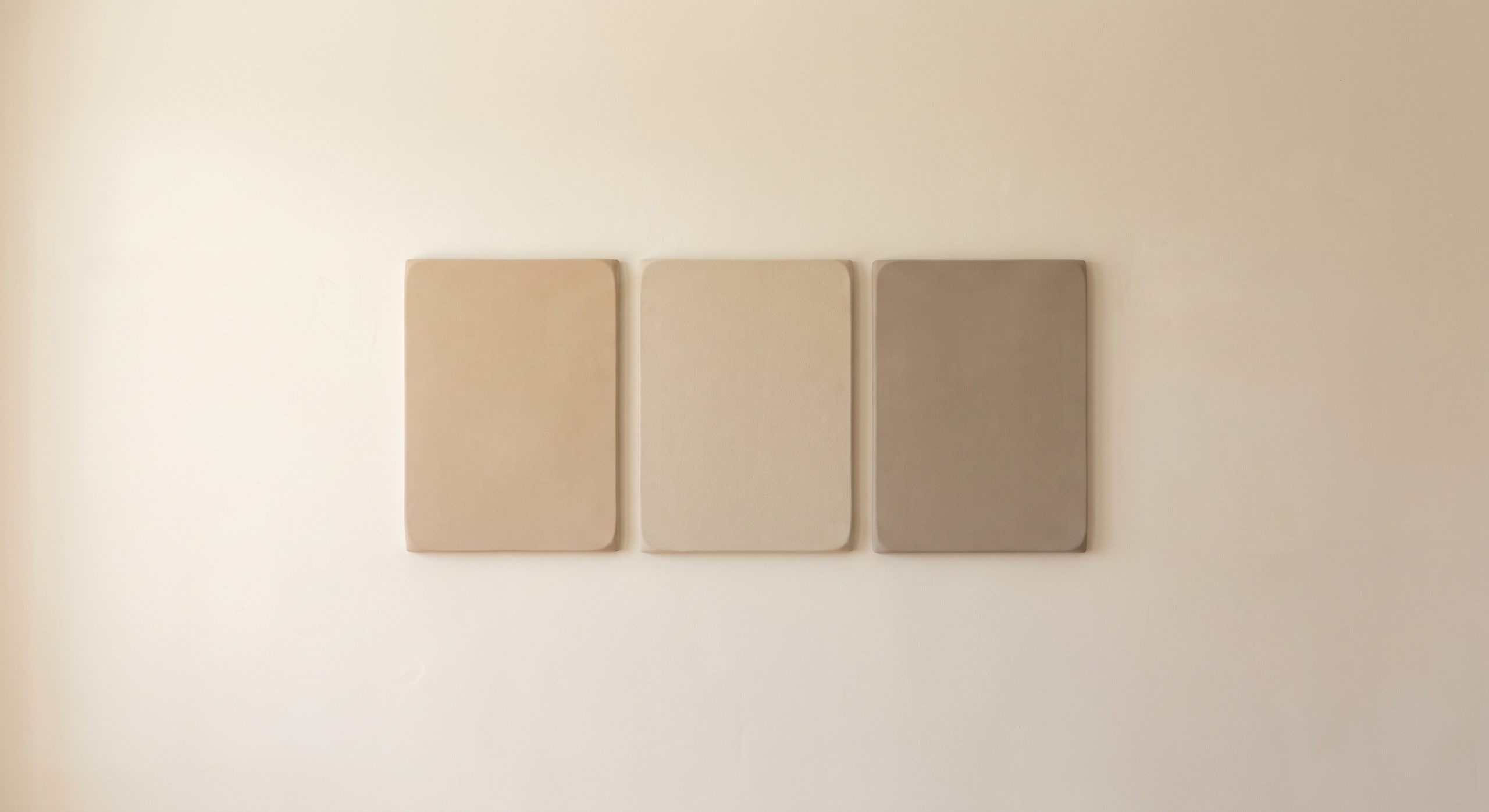
Many minimalist works repeat identical or closely related elements in a regular pattern. The repetition removes the sense of a “composed” picture and replaces it with a calm, measured rhythm.
Emphasis on surface and space
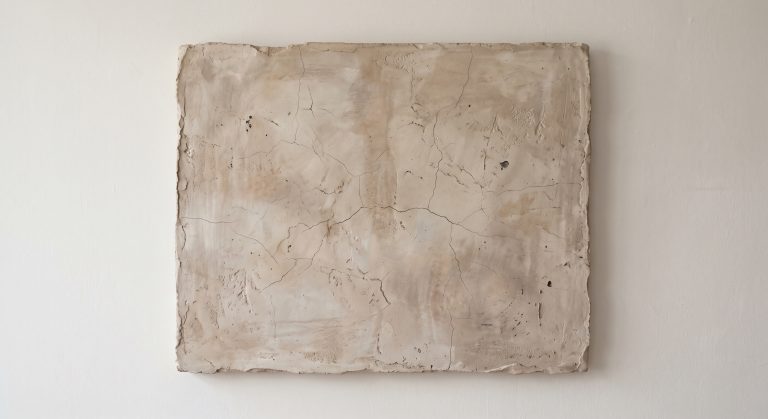
Because there is so little to look at, the surface, the edges and the space around the work become part of the experience. This is closely related to the ideas in negative space in abstract art.
Repetition in Practice
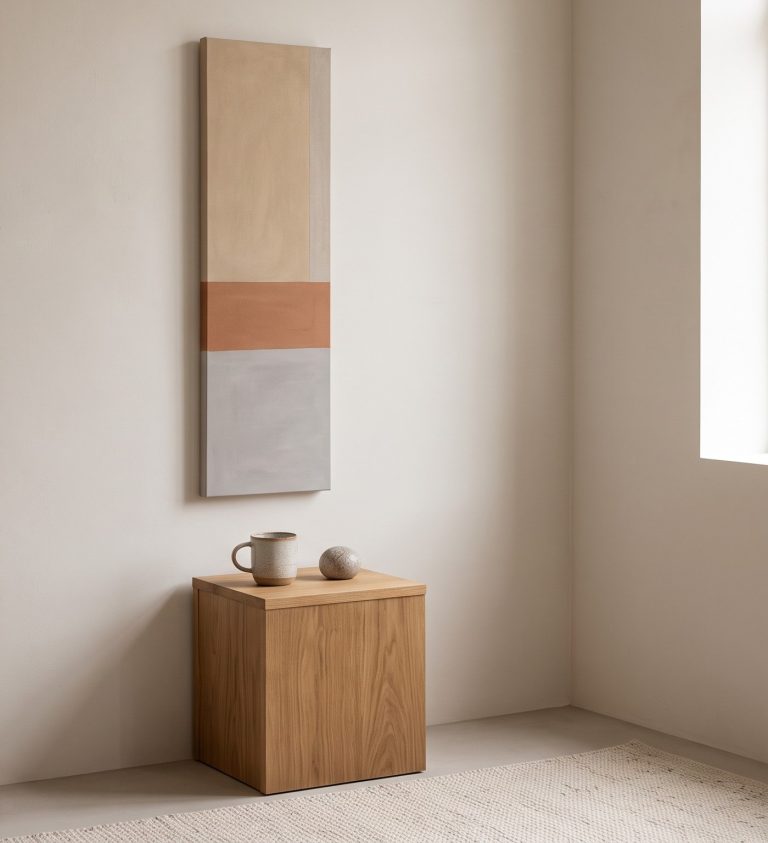
A simple example: three identical soft-edged rectangles in a row, each in a slightly different tone. There is no story and no drama. But the eye begins to compare them, to notice the small shifts in tone and the intervals between them, and the quiet rhythm becomes the experience.
Minimalist Art vs Abstract Art
The two overlap, but they are not the same.
- Abstract art is the broad family of art that does not directly represent the visible world. It includes expressive, gestural, geometric and textured work.
- Minimalist art is a narrower approach, defined by extreme reduction and restraint.
Minimalism is a type of abstraction, but plenty of abstract art is not minimalist at all. A dense, energetic gestural painting is abstract without being minimal. We explain the wider family in the different types of abstract art.
Minimalist Art vs Minimalist Decor
Minimalist art is an artistic approach. Minimalist decor is an interior style that favours few objects, clean surfaces and uncluttered rooms.
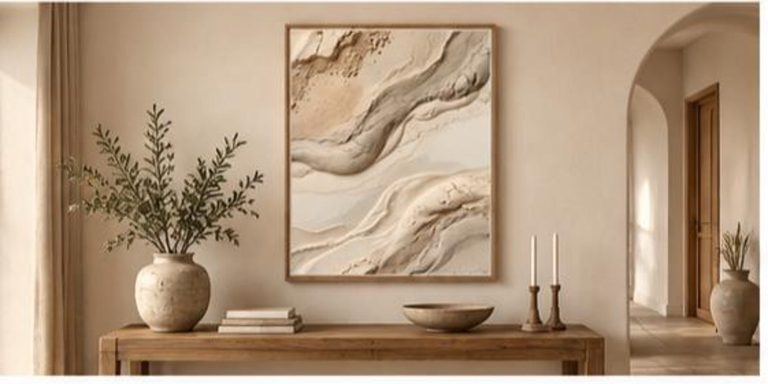
They pair well, but one does not require the other. A minimalist artwork can hang in a warm, layered room, and a very spare room can hold a rich, expressive painting. The best pairings feel intentional rather than automatic.
Common Misunderstandings
- “Anyone could make that.” Reduction is hard. With so little on the surface, small errors in proportion or spacing are obvious.
- “It has no meaning.” Minimalist artists often wanted the viewer’s direct experience of form, space and material to be the meaning.
- “It is cold.” It can be, but softly toned, textured minimalist work can feel warm and very calm.
- “It has to be black and white.” Minimalist palettes can be warm, earthy and gentle.
How to Look at Minimalist Art
Slow down. There is less to see, so it repays attention.
- Notice proportion. How large is the mark compared with the surface around it?
- Notice edges. Are they crisp, soft or slightly uneven?
- Notice tone. In a neutral piece, small shifts in tone carry a great deal.
- Notice the space. Where does the emptiness sit, and how does it feel?
- Notice yourself. Minimalist work often works by making you aware of your own looking.
Living With Minimalist Art at Home
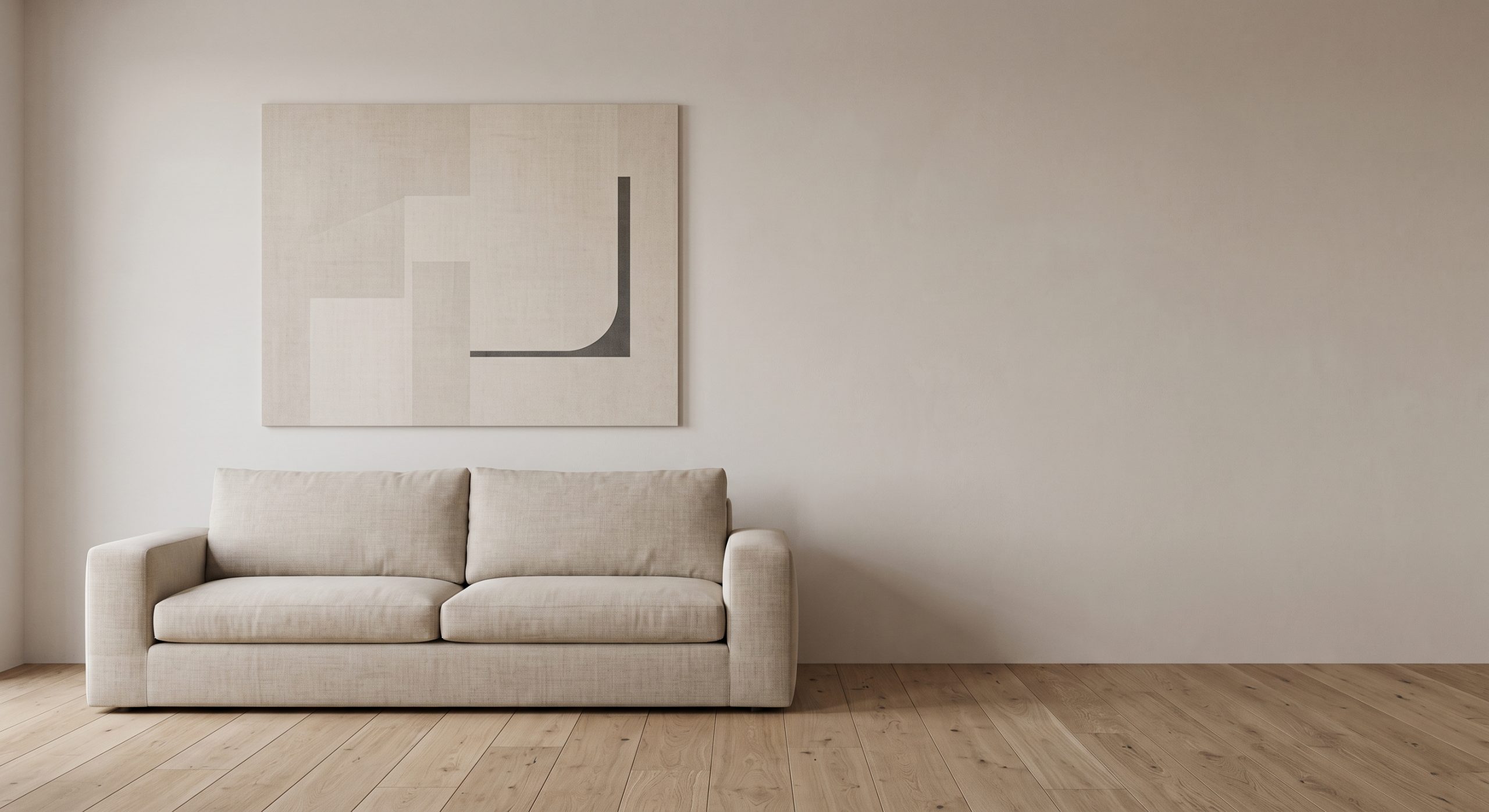
Minimalist pieces are among the easiest art to live with, because they rarely compete with furniture or other objects. They suit bedrooms, hallways, studies and small spaces particularly well.
A few principles help:
- Give the piece room. Empty wall around it is part of the work.
- Choose scale confidently. A larger minimalist piece often looks more resolved than a small one floating on a big wall.
- Mind the surface. In a restrained piece, subtle texture or a fine tonal shift adds depth without adding clutter. See textured abstract art.
- Check the balance. Asymmetry can feel quietly confident. See understanding balance in abstract art.
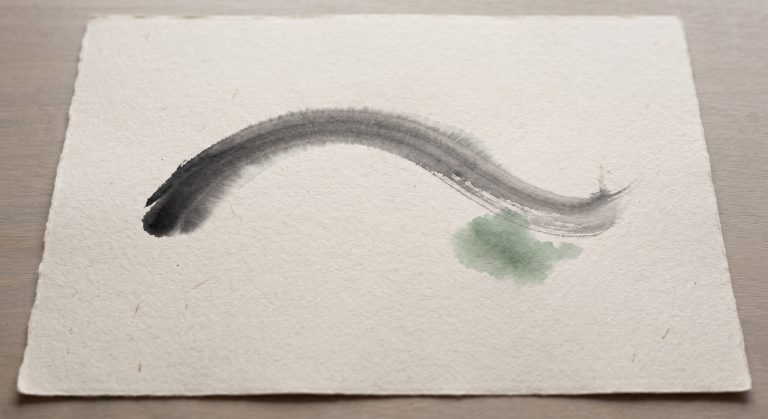
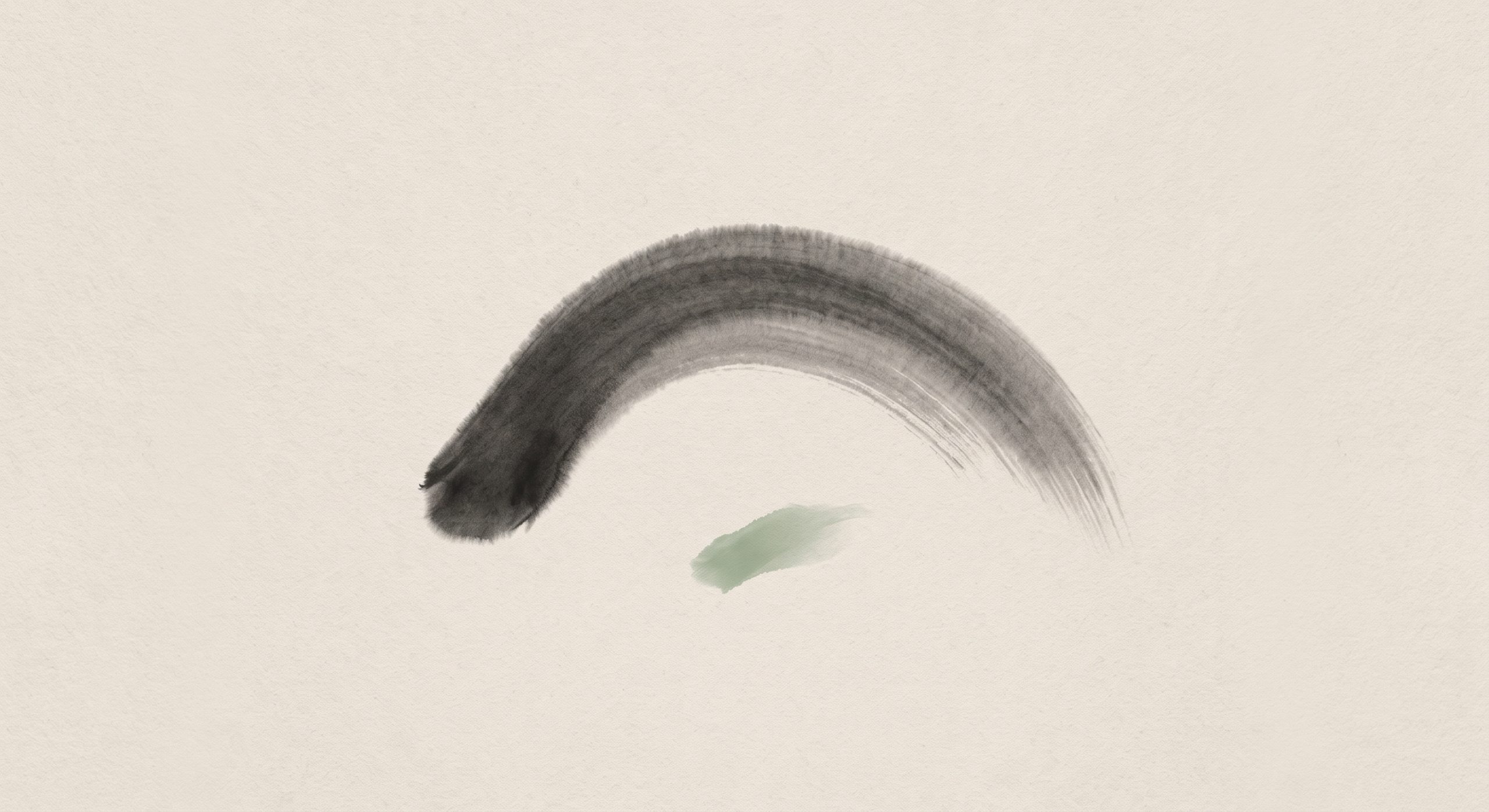
For a broader process, read how to choose abstract art for your home. If you’re drawn to the drawn line as a minimalist language, our guide to minimalist line art is the natural next step, and the Scandinavian-Japanese blend in Japandi art shows how minimalism can be softened with warmth and natural material.
Final Thoughts
Minimalist art is not about having nothing. It is about keeping only what matters.
Once you learn to see that restraint, a single line or a quiet surface starts to feel full. And in a busy world, a wall that lets you rest your eyes is worth more than it may seem. For the fuller process of choosing and placing a piece, see the complete guide to choosing artwork for your home.