
Best Wireless Picture Lights for Artwork: 7 Stylish Options for 2026
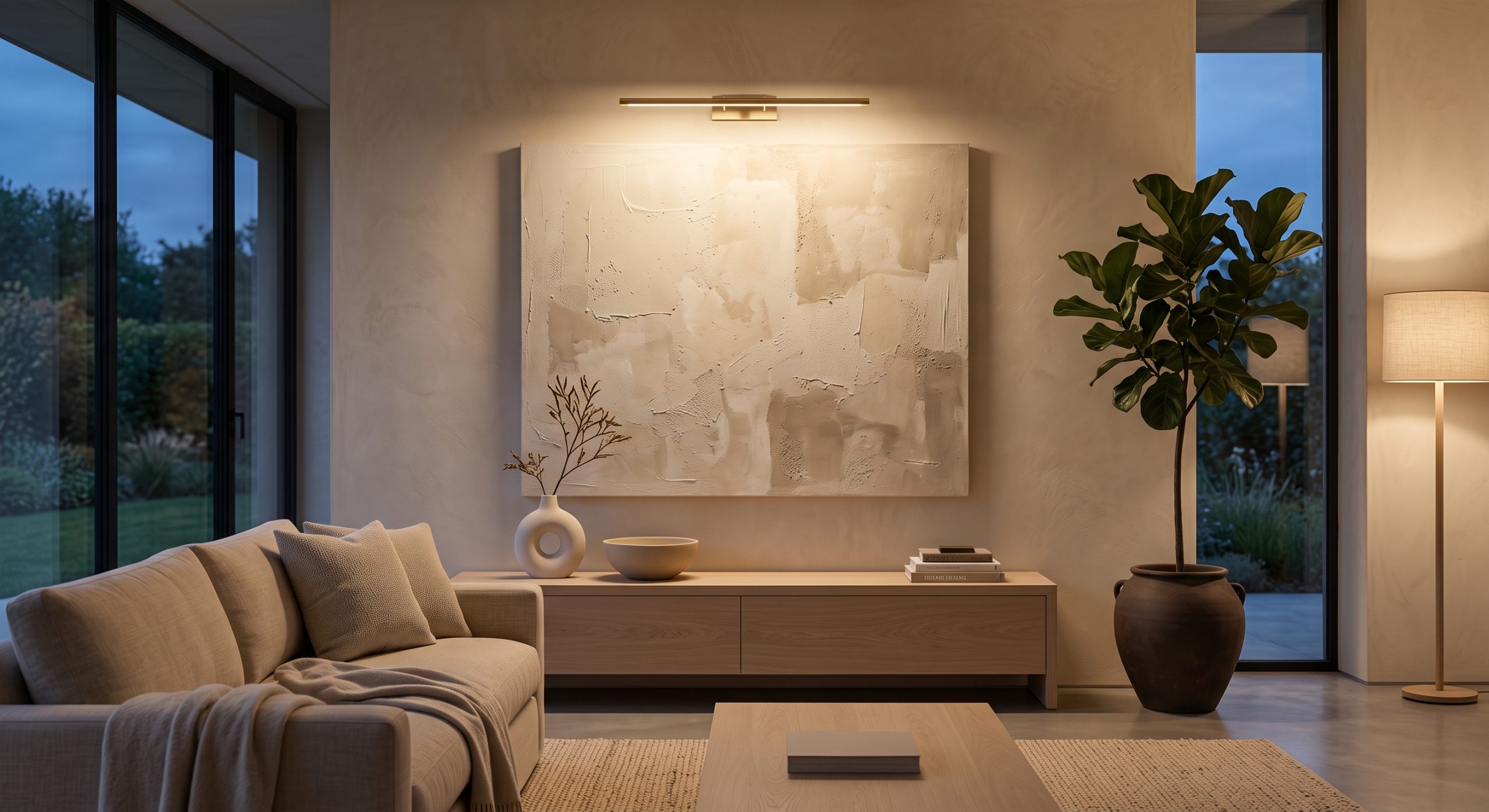
Lighting changes the way artwork feels in a room more than almost anything else. A painting that glows in morning daylight can all but vanish by evening, its soft creams turning grey and its texture flattening into a blur. The right picture light brings it back.
You no longer necessarily need an electrician or visible wiring to do it. When choosing a wireless picture light, the main things to weigh up are:
- Size: a light in proportion to the width of the artwork
- Colour temperature: warm to neutral white, with 2700K–3000K suiting most warm, neutral interiors
- Colour rendering (CRI): a higher CRI if accurate colour matters to you
- Battery life: how long it runs at your preferred brightness, and how often you are happy to recharge
- Format: one light, several for a gallery wall, or a softer alternative such as wall sconces or an uplighter
Done well, the effect is lovely: colour regains its warmth, raised surfaces catch little ridges of shadow, and the wall takes on the considered atmosphere of a small gallery.
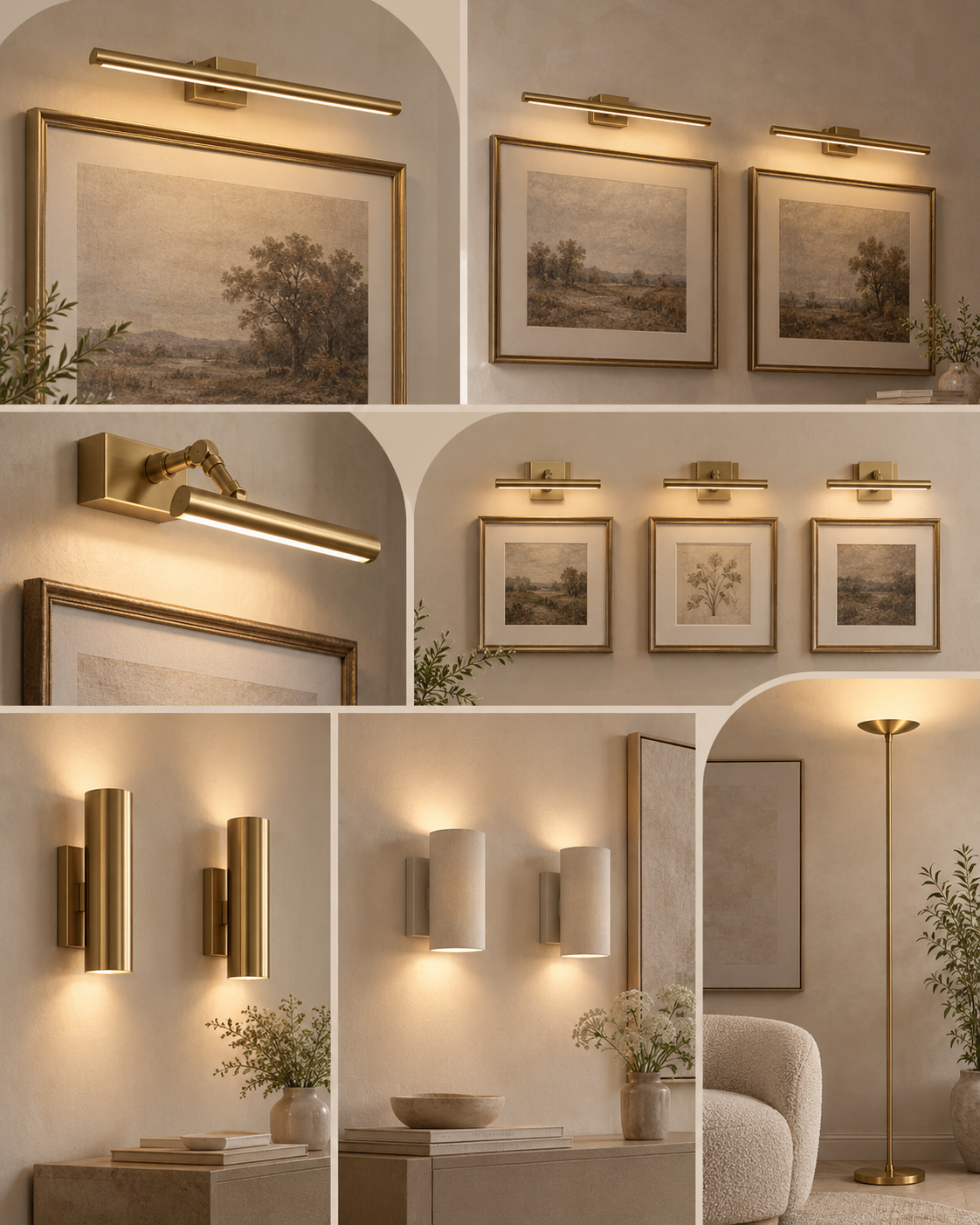
Below are seven rechargeable and wireless artwork-lighting options for different types of art and interiors, from traditional picture lights to wall sconces and an ambient uplighter.
As an Amazon Associate I earn from qualifying purchases. This does not affect the price you pay. We may earn a commission when you purchase through qualifying links in this article.
Best Wireless Picture Lights for Artwork at a Glance
If you want the short version, these are the options we would consider first:
- Best overall: YITGOG Rechargeable Picture Light
- Best for colour accuracy: Kitloo Rechargeable Picture Lights
- Best adjustable option: EZVALO Rechargeable Picture Light
- Best for gallery walls: Homelist 3-Pack Picture Lights
- Best side-lighting alternative: TaoFiaCo Rechargeable Wall Lights
- Best renter-friendly alternative: Ollny Rechargeable Wall Lights
- Best for ambient feature-wall lighting: HUAEU Uplighter Floor Lamp
If you are lighting one statement artwork, start with a traditional picture light. If you have several coordinated pieces, a multi-pack usually makes more sense.
For larger feature walls, or rooms where you would rather not have a fixture directly above the frame, rechargeable wall sconces or an uplighter create a softer alternative.
A note on specifications: battery sizes, running times and features below are taken from the manufacturers’ Amazon listings at the time of writing. They are manufacturer claims, not results of our own testing. Listings change, so check the current details before you buy.
Why Good Lighting Makes Artwork Look Better
Artwork never exists separately from the room around it. The amount, direction and colour of the light falling on a piece shape how we see its colour, contrast and texture.
The difference is most noticeable with:
- Textured canvas art
- Neutral abstract artwork
- Oil paintings
- Dark or richly coloured paintings
- Metallic details
- Relief artwork
- Framed prints behind glass
- Gallery walls
During the day, windows do much of this work naturally. At night, ceiling lights rarely reach artwork from a flattering direction, and a neutral piece in particular can lose all its subtlety. A dedicated picture light solves that, and quietly makes the artwork the focal point of the room.
1. YITGOG Rechargeable Picture Light — Best Overall
For a single statement painting or framed artwork, the YITGOG rechargeable picture light is one of the most versatile choices in this selection.
The current listing describes a built-in rechargeable battery, with running times that vary according to the brightness setting.
Its wireless design is particularly useful where you want the look of a permanently installed picture light without chasing electrical cable into the wall.
Why it stands out:
- Rechargeable rather than disposable batteries
- Wireless installation
- Suitable for paintings, framed prints and display pieces
- Clean, gallery-inspired appearance
Best for: A large individual artwork in a living room, bedroom, hallway or dining space.
Consider if: You want a traditional picture-light appearance without permanent electrical wiring.
2. Kitloo Rechargeable Picture Lights — Best for Colour Accuracy
If faithful colour is your priority, the Kitloo lights are particularly interesting. They are sold as a two-light set. The current product listing states a CRI of 95 or above, which may help reproduce artwork colours more accurately than lower-CRI lighting.
CRI stands for Colour Rendering Index. A higher CRI generally means a light source reveals colours more naturally than a low-quality one.
This matters most with paintings built on subtle colour variation. Soft beige, taupe, stone, terracotta, green and other muted shades can look flat or slightly distorted under poor artificial light, losing exactly the quiet differences that make them beautiful.
Why they stand out:
- Two lights included
- Rechargeable design
- Listed CRI of 95 or above
- Remote control and timer
Best for: Colour-rich artwork, detailed paintings and two coordinating artworks.
Consider if: Colour accuracy matters more to you than simply creating decorative ambient light.
3. EZVALO Rechargeable Picture Light — Best Adjustable Option
Lighting artwork becomes much easier when you can change the angle of the light.
The current listing describes the EZVALO picture light as having a magnetic design and a rechargeable 4800mAh battery.
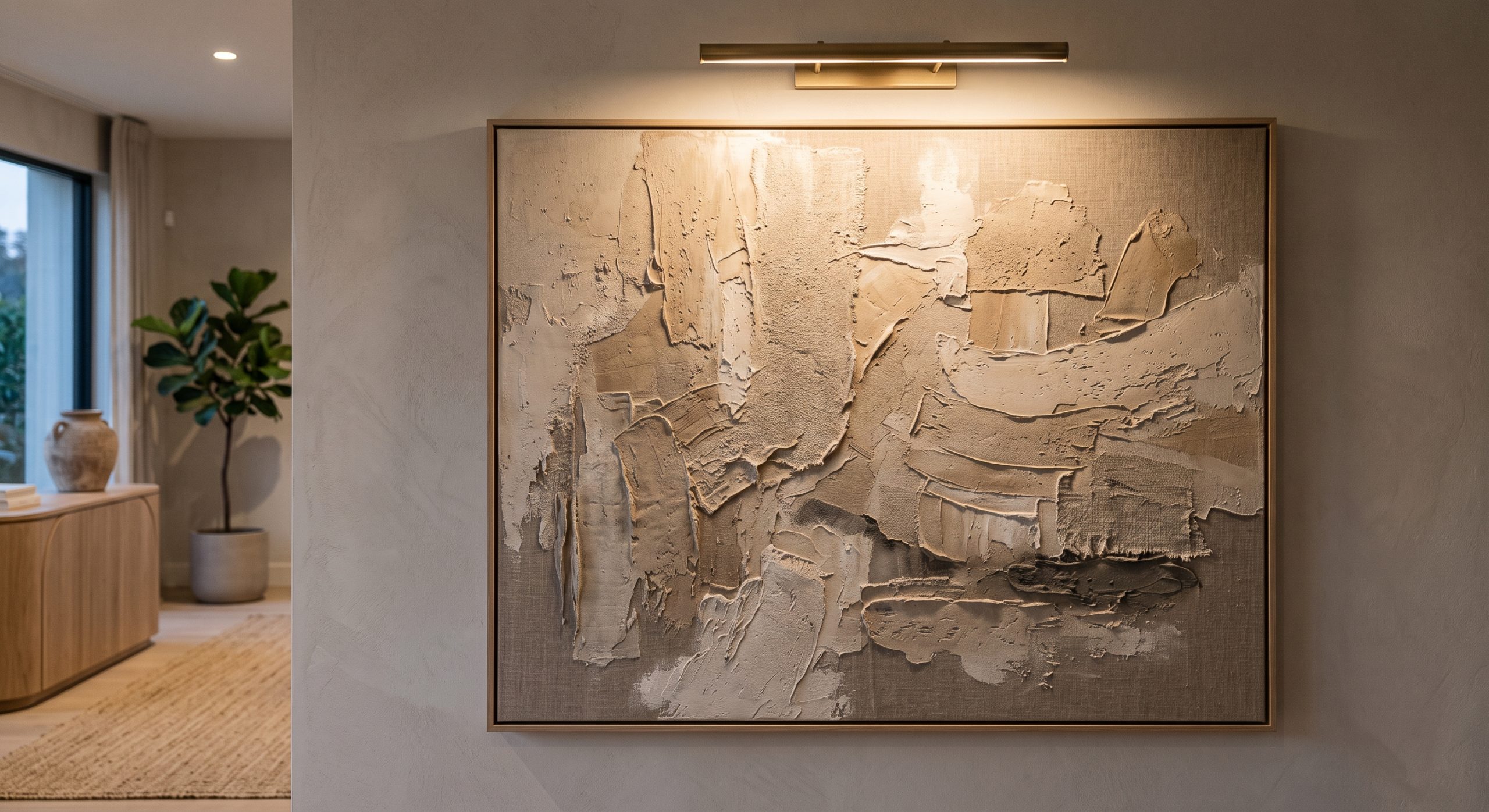
An adjustable angle is especially useful with textured artwork. Rather than washing the surface flatly and evenly, a slight angle draws out small highlights and shadows. This can make:
- Raised textures more visible
- Brushwork more pronounced
- Sculptural artwork feel deeper
- Neutral artwork appear less flat
Why it stands out:
- Magnetic design
- Rechargeable battery
- Cordless installation
- Remote control
- Useful for experimenting with lighting angles
Best for: Textured abstracts, dimensional artwork and rooms where you want more control over the direction of light.
Consider if: You enjoy adjusting the atmosphere of a room rather than using one fixed lighting position.
4. Homelist 3-Pack Rechargeable Picture Lights — Best for Gallery Walls
A single picture light is not always the answer for a gallery wall. When several pieces are spread across a larger stretch of wall, multiple smaller lights give more balanced illumination.
The Homelist set includes three rechargeable lights. The listing specifies a 2200mAh battery in each light, three white colour temperatures, dimming and 12 RGB colour options.
For most artwork, we would favour one of the natural white settings over coloured RGB light. The extra flexibility is still useful if the same room doubles as a space for entertaining or mood lighting.
Why it stands out:
- Three lights included
- Suitable for multi-piece displays
- Rechargeable
- Adjustable brightness
- Multiple white colour temperatures
- Remote control
Best for: Gallery walls, triptychs and groups of three coordinated artworks.
Consider if: You need to light several artworks rather than one large central piece.
If you are planning the arrangement as well as the lighting, our guide on how to plan a gallery wall layout covers measuring, spacing and choosing an anchor piece.
5. TaoFiaCo Rechargeable Wall Lights — Best Side-Lighting Alternative
Picture lights do not have to sit directly above the artwork. A pair of wall lights or sconces on either side of a large central piece is another elegant option, framing the art in two soft pools of light.
This works particularly well with:
- Large abstract canvases
- Traditional paintings
- Artwork above a console table
- Dining-room art
- Bedroom artwork
- Symmetrical interiors
The TaoFiaCo rechargeable wall lights offer a cordless way to create this look. Instead of the light becoming part of the frame, the sconces become part of the wider room design.
Best for: Large statement artwork with enough wall space on either side.
Why it stands out: It creates a more architectural, interior-designed look and can provide ambient room lighting at the same time.
Consider if: Your wall is wide enough to accommodate both artwork and side lighting comfortably.
6. Ollny Rechargeable Wall Lights — Best Renter-Friendly Alternative
Renting does not mean your artwork has to disappear into a dark wall every evening. Cordless rechargeable wall lights offer an alternative where permanent electrical work is not practical.
The Ollny lights are designed as wireless wall fixtures rather than traditional picture lights. Positioned near artwork, they can create a pool of light around a feature wall without a visible power lead running down to a socket.
Best for: Rental homes, bedrooms, hallways and flexible decorating schemes.
Why they stand out: They make it easier to experiment with lighting placement than conventional wired fixtures.
Consider if: You expect to move the artwork later or simply do not want a permanent lighting installation.
7. HUAEU Uplighter Floor Lamp — Best for Ambient Feature-Wall Lighting
Not everyone wants a lamp fixed above their artwork. If you would rather make the whole wall feel atmospheric than spotlight the painting itself, an uplighter can be lovely.
Positioned near a wall, an uplighter throws light upwards in a soft, gradual wash. It works particularly well:
- In corners
- In living rooms
- Behind occasional furniture
- Beside large canvases
- On feature walls
- In rooms with warm evening lighting
This is less about revealing every detail of a painting and more about creating atmosphere around it. Unlike the other picks, it is included as an alternative ambient-lighting method rather than a wireless picture light, so check the listing for how it is powered before choosing where it will go.
Best for: Large feature walls and contemporary interiors.
Consider if: You prefer indirect ambient lighting to a traditional gallery-style picture light.
What Colour Temperature Is Best for Artwork?
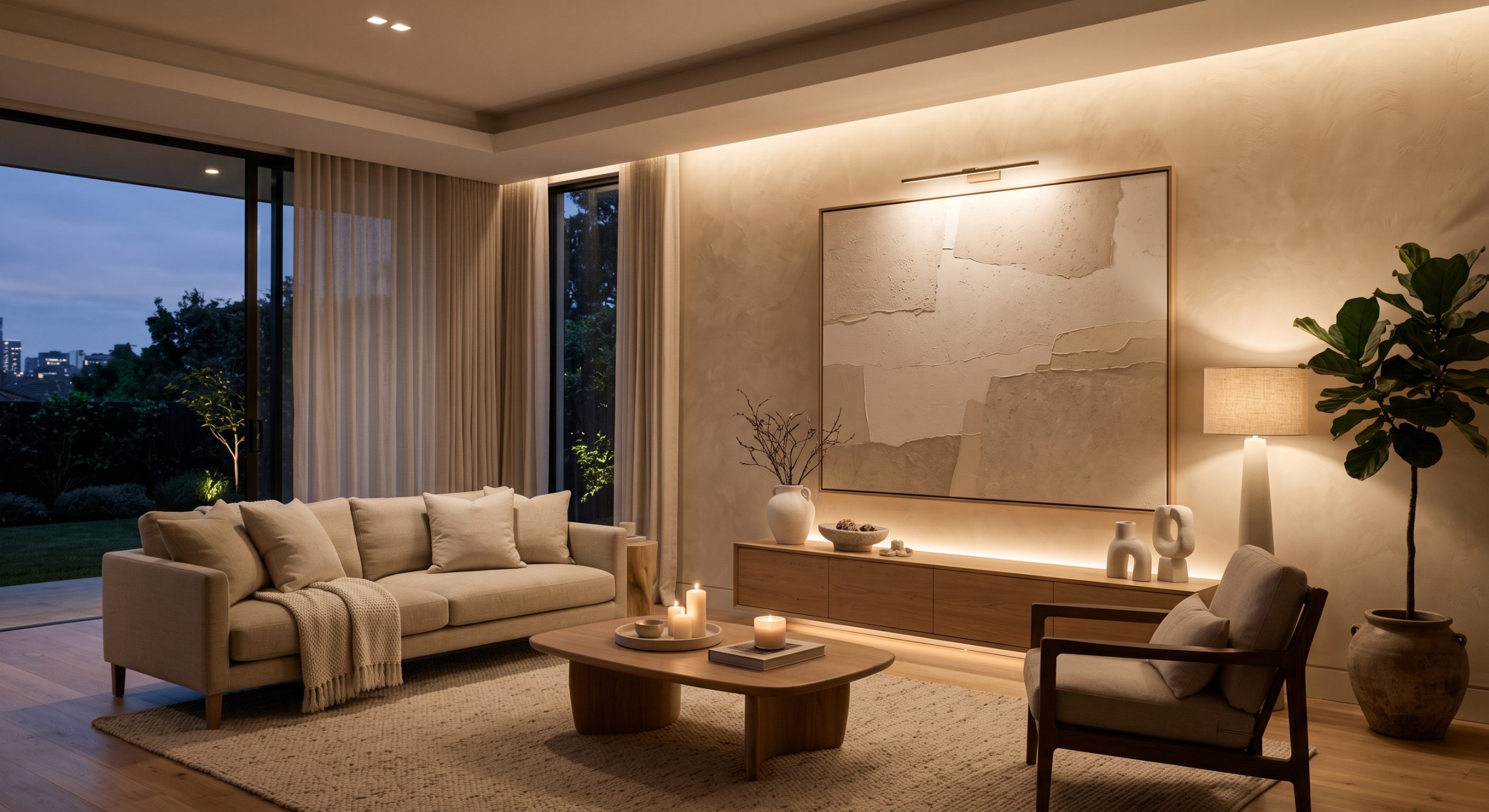
Colour temperature has a surprisingly large effect on how artwork looks. It is measured in Kelvin, usually shown as K. As a simple guide:
2700K–3000K: Warm, soft light. Particularly suited to warm neutral interiors, traditional paintings, earthy abstracts and cosy living spaces.
Around 3500K–4000K: More neutral-looking light. Useful when you want colours to appear cleaner without creating a cool atmosphere.
Higher colour temperatures: A cooler, crisper look that can feel less relaxing in warm residential interiors.
No single colour temperature suits every piece. The advantage of a picture light with several settings is that you can compare them against the actual artwork and the room around it.
Why CRI Matters When Lighting Paintings
CRI, or Colour Rendering Index, describes how accurately a light source reveals colours. For general room lighting, most people never think about it. For artwork, it matters more.
A painting may contain tiny variations between cream, stone, ochre, grey, brown or muted green. Poor lighting can make those differences harder to see. A high-CRI picture light is particularly useful for:
- Fine art
- Colour-rich paintings
- Photography
- Botanical art
- Detailed illustrations
- Neutral artwork with subtle tonal differences
What Size Picture Light Should You Choose?
The light should feel visually connected to the artwork without overpowering it. An oversized picture light can look heavy above a small framed print, while a tiny light above a large canvas may only illuminate the centre.
Consider:
- Artwork width
- Frame width
- Beam spread
- Distance between the light and the artwork
- Whether you want even illumination or dramatic directional light
For large artwork, a wider picture light or several light sources give better coverage. For gallery walls, several smaller lights are often more effective than trying to light the whole composition from one point. For a fuller walkthrough with a size chart, see what size picture light do I need.
Are Rechargeable Picture Lights Any Good?
For many homes, yes. Their biggest advantage is convenience: you get the effect of dedicated artwork lighting without installing mains wiring.
Advantages include:
- No trailing power cable
- No nearby socket required
- Less invasive installation
- Easy repositioning
- Suitable for many rental properties
- Rechargeable batteries reduce disposable battery use
- Many include remotes and timers
There are compromises. The battery needs regular charging, and running at maximum brightness usually shortens the operating time.
For artwork that needs lighting for many hours every day, a professionally wired fitting may still make more sense. For typical evening use in a living room, bedroom or hallway, rechargeable lights are a very practical solution.
How to Light Artwork Without Wiring
There are several ways to light artwork without running permanent electrical cable through a wall.
Use a Rechargeable Picture Light
This produces the most recognisable gallery-style appearance.
Use Rechargeable Wall Sconces
Place them beside the artwork rather than directly above it.
Use a Floor Uplighter
This lights the surrounding wall and creates atmosphere rather than spotlighting the piece directly.
Use Multiple Small Rechargeable Lights
This works particularly well for gallery walls and triptychs.
For more ideas, including placement tips for each approach, read our full guide on how to light artwork without wiring.
How to Light Abstract and Textured Wall Art
Abstract art responds particularly well to directional lighting, especially when a piece contains:
- Raised surfaces
- Visible brush strokes
- Plaster effects
- Linen texture
- Stone-like detail
- Sculptural forms
Light from slightly above, or from an angle, casts tiny shadows across those surfaces. That extra contrast can make a quiet, neutral piece feel far more dimensional, as though the surface has been gently sculpted. Our guide to textured abstract art explains how that depth is built into a piece in the first place.
Very flat, even lighting gives a different result. It shows the composition clearly but can soften the shadows that make texture visible.
If your light is adjustable, experiment. Moving it by only a small angle can change how the artwork reads.
If you are still choosing the artwork itself, our guide on how to choose abstract art for your home covers mood, colour, scale and texture.
Should You Put a Picture Light Above Every Artwork?
No. Lighting should feel intentional, and a single illuminated statement piece often has more impact than a light above every frame in the room.
Think about hierarchy. Which artwork do you want someone to notice first? That is usually the piece worth lighting.
For a gallery wall, either light the whole composition evenly or choose lighting that visually unifies the display.
Picture Lights vs Spotlights — Which Are Better?
Both can work. Picture lights create a more traditional gallery effect and become visually connected to the artwork. Ceiling spotlights are more discreet because the fitting sits away from the frame.
Picture lights are particularly attractive when:
- Wiring from the ceiling is unavailable
- You want the fixture to become part of the display
- The artwork may move
- You prefer a classic gallery look
Spotlights may be preferable when:
- Ceiling lighting is already installed
- You want no visible fitting around the artwork
- Several artworks need lighting from above
Which Wireless Picture Light Would We Choose?
For a straightforward single artwork, the YITGOG is our strongest all-round choice from this group.
For colour-sensitive artwork, the Kitloo stands out for its emphasis on colour rendering.
For textured art where you want to experiment with angle, we like the adjustability of the EZVALO.
For a three-piece gallery wall, the Homelist set is a convenient multi-light solution.
And if you would rather not have a conventional picture light at all, rechargeable sconces or an uplighter create a softer, more decorative alternative.
Final Thoughts
Good artwork deserves to be seen after sunset.
Rechargeable picture lights have made artwork lighting far more accessible by removing one of its biggest obstacles: wiring.
The right choice depends on the artwork itself. A traditional picture light can turn one painting into a focal point. Several rechargeable lights can bring cohesion to a gallery wall. Wall sconces create symmetry around large canvases, while an uplighter can change the feel of an entire feature wall.
The aim is not simply to make the artwork brighter. It is to use light to reveal what drew you to it in the first place: the colour, the texture, the form, and the particular mood it brings to a room in the evening.
Frequently Asked Questions
Can you use a rechargeable picture light above a painting?
Yes. Rechargeable picture lights are designed for exactly this. Check the beam width, dimensions and mounting instructions against the size of your artwork before installing.
Do wireless picture lights need an electrical socket?
Not while operating, if they contain a rechargeable battery. They still need recharging periodically.
What colour light looks best on paintings?
Warm to neutral white is often the most natural choice in homes. Adjustable lights are useful because the best result depends on the colours in both the artwork and the room.
Can I light artwork in a rented home?
Yes. Rechargeable lights are particularly useful where permanent electrical work is not an option. Always choose a mounting method suitable for the wall and your tenancy conditions.
Can picture lights be used on a gallery wall?
Yes. For larger arrangements, several coordinated lights usually give more balanced coverage than one central lamp.
Is warm or cool light better for abstract art?
It depends on the palette. Warm neutral artwork often looks particularly inviting under warmer light, while cooler or strongly coloured contemporary pieces may suit a more neutral white.
Do picture lights make artwork look more expensive?
Good lighting makes artwork look more intentional. It increases contrast between the piece and the wall, brings out surface detail and creates the focal lighting associated with professionally designed interiors.
